
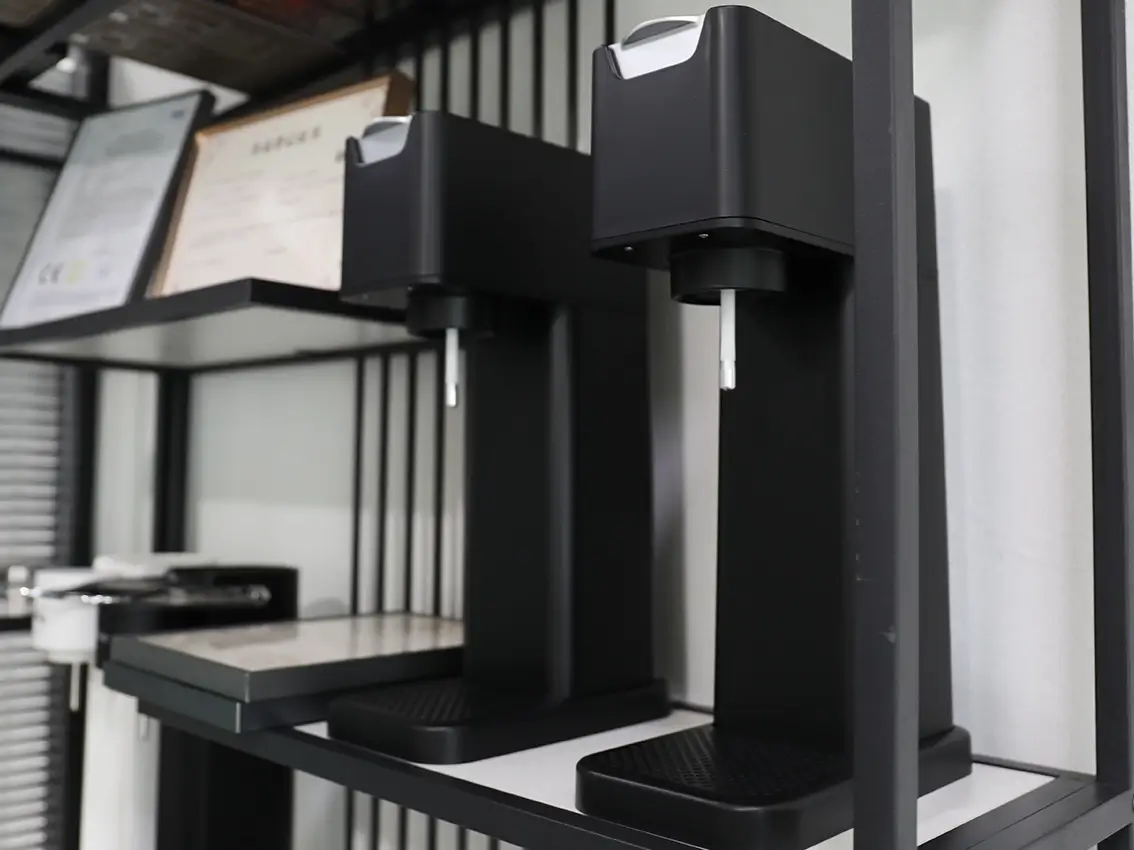
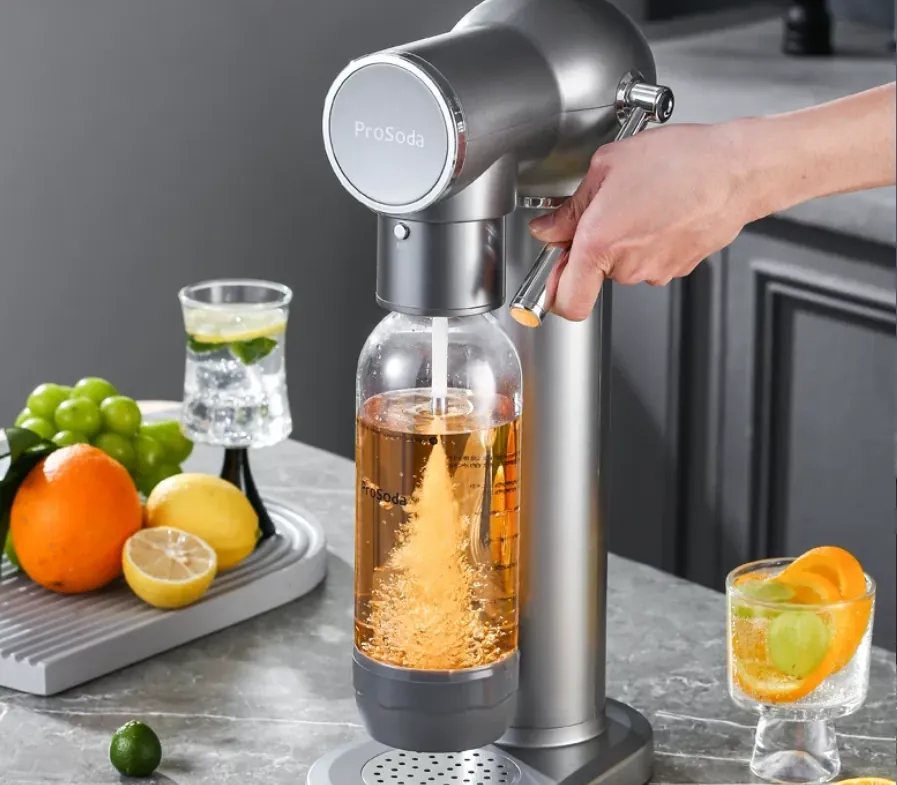
A manual soda maker carbonates with the pressure stored in the CO2 cylinder itself: a top-press button or a lever opens a mechanical valve, and the user controls the fizz pulse by pulse — no mains electricity anywhere in the process. An electric soda maker adds a mains-powered pump and preset controls on top of the same cylinder. For a private label soda maker programme, that one difference decides almost everything downstream — certification scope, plug and voltage variants, shipping, and how much after-sales your channel has to carry — which is why most private label ranges start with the manual platform and add branding on top of it.
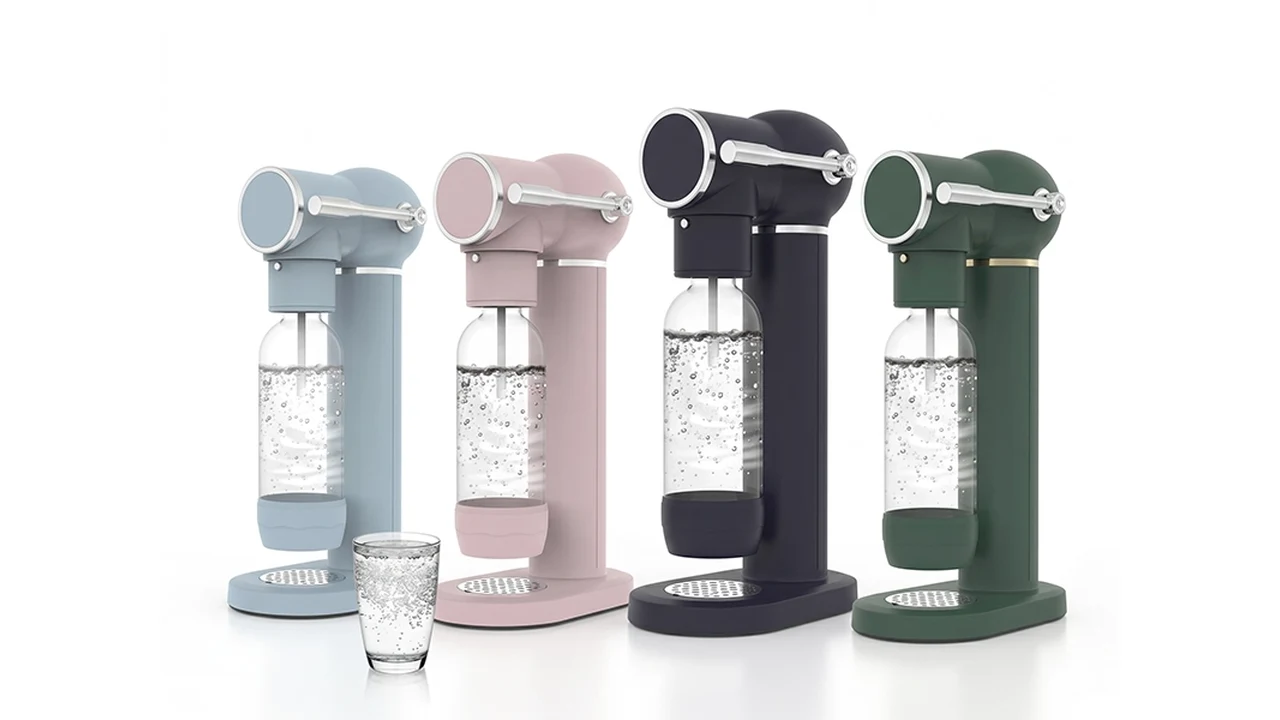
What is the actual difference between a manual and an electric soda maker?
Both types dissolve food-grade CO2 into cold water inside a sealed, pressure-rated bottle; how a soda machine works covers that shared mechanism in detail. The difference is where the work comes from and who controls it.
In a manual machine, the cylinder is the power source. Pressing the button or working the lever opens a CNC brass valve — fitted across our whole range — and each pulse sends a burst of gas through the nozzle below the water surface. Carbonation level is set by the user’s hand: fewer pulses for a soft sparkle, more for a sharp fizz. On our stainless G15, a magnetic sound signals that target pressure is reached, and the valve closes automatically at that point, saving roughly 1 g of gas per fill against the roughly 10 g a litre of water needs.
In an electric machine, a motorised pump driven from the mains does the injecting, and the user picks a preset level instead of pulsing by hand. That buys one-touch repeatability, and it costs a power cord, a plug and voltage variant per market, electronic controls that can fail, and an electrical-appliance certification route in most destination markets. Neither type changes the water, the bottle discipline or the cylinder standard — those stay the same on both platforms.
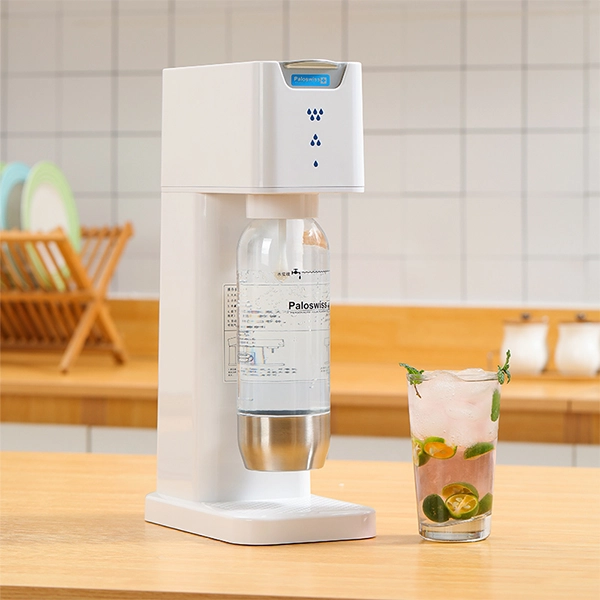
Factory footage showing the G830 soda maker mass production and assembly process for OEM and private-label orders.
Manual vs electric soda makers, side by side
The table below is the version we walk brand buyers through when the platform decision is still open. It compares the two categories, not two specific models.
| Decision point | Manual soda maker | Electric soda maker |
|---|---|---|
| Power source | None — gas pressure does the work | Mains electricity, plug and voltage per market |
| Fizz control | Pulse by pulse, set by the user each fill | Preset levels, one-touch repeatability |
| Certification scope | Food-contact and pressure-related documentation | The same, plus an electrical-safety route for a mains appliance |
| Market variants | One hardware platform; only carton, manual language and labels change | Plug, voltage and certification variants per destination |
| Shipping and storage | No powered electronics to protect or test | Electronics need the usual appliance handling and compliance marks |
| Typical failure points | Seals, nozzle, valve — mechanical parts | Those, plus pump, board and power components |
| After-sales | Channel can stock seals, nozzles and valves as spare parts | Powered faults usually need a service centre |
| Best fit | Private label ranges, distributors, multi-market programmes | Single-market premium retail with an existing appliance service network |
Two rows do most of the deciding in practice: certification scope and after-sales. A manual platform keeps one hardware build saleable across many markets, and the faults a retailer will actually see — a worn seal, a blocked nozzle — are parts a distributor can hold and swap. That is the practical background to the platform advice in the next section.
Why do private label programmes usually start with manual machines?
Because a private label launch is a packaging, artwork and channel project long before it is an engineering one — and the manual platform keeps the hardware side of that project as small as possible. Four reasons come up in almost every programme review:
- One platform, many markets. With no plug, voltage or frequency variants, the same machine build ships to every destination; what changes per market is the colour box, the manual language, the barcode and the carton marks. Our private label programme is built around exactly that split: fixed hardware, localised packaging.
- A shorter compliance file. Food-contact material tests and pressure-safety documentation are required either way — our quality and compliance page sets out that side. A manual machine simply does not add the electrical-safety layer a mains appliance carries on top, so the document set a new brand must assemble stays shorter.
- Simpler logistics. There are no powered electronics to protect in transit or to function-test on arrival, and the range is built around one refillable threaded cylinder standard (TR21-4 valve, M18×1.5 thread; the 425 g / 60 L screw-in type), as set out in the CO2 cylinder compatibility guide.
- After-sales a channel can actually run. Valves and connectors are sold separately as spare parts, seals and nozzles are user-replaceable, and there is no powered component whose failure writes the whole unit off in the customer’s kitchen.
None of this makes a manual machine the better product for every shelf — the next two sections cover the honest exceptions. It makes it the lower-risk first platform for a brand that is still proving its market.
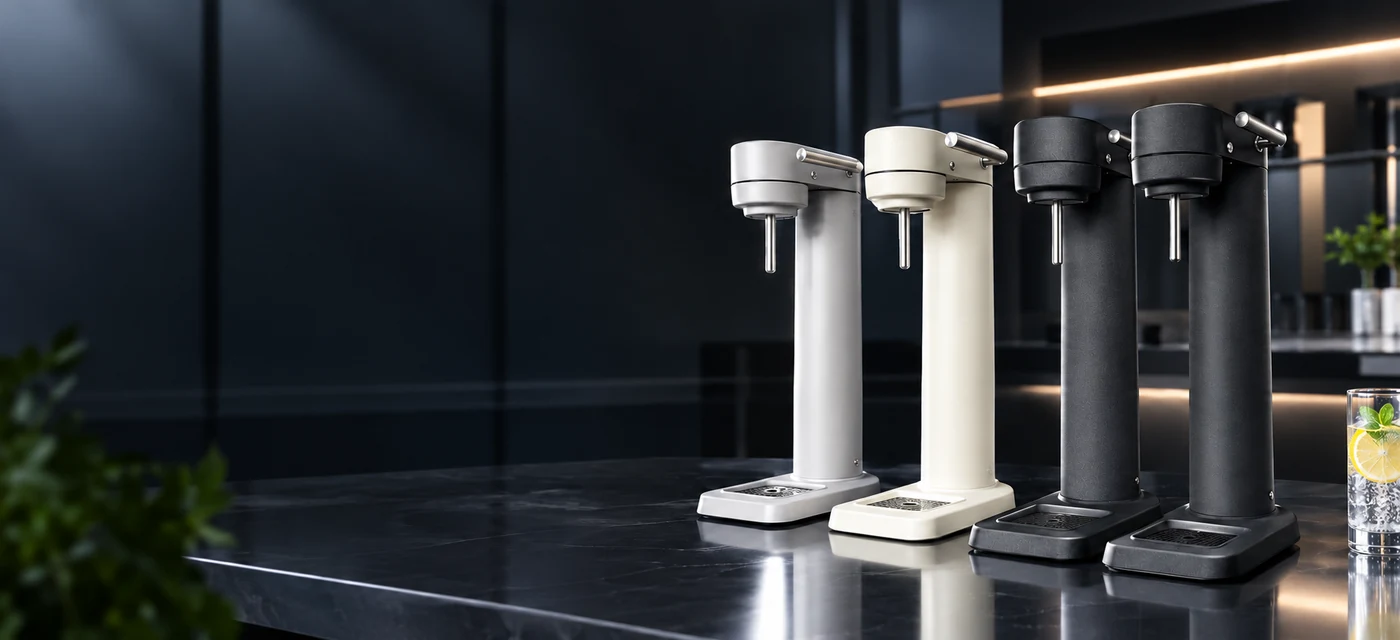
One manual platform, your brand on it — private label from 300 units.
The G3 has an LED — does that make it electric?
No, and the distinction is worth making precisely, because buyers ask it often. The LED carbonation-level indicator on our G3 runs on a single CR123A 3 V cell. It powers only the indicator light. Carbonation, pressure release and every safety function on the machine are mechanical: double safety valves, a CNC brass valve, and controlled venting before the bottle comes out. Documentation for the cell is complete and on file, and it never touches the gas path.
For buyers who want no battery in the product at all, the same platform exists without the light: the G9 is the G3 platform with the LED removed and everything else unchanged. That option — indicator or no indicator, same mechanics — is only available because the base platform is manual. On an electric machine, the electronics are the product, and there is no equivalent “without” version.
When does an electric soda maker make sense instead?
Honesty about our own position first: we manufacture manual machines only, so this comparison is platform advice from a manual maker, and it should be read with that in mind. There are programmes where electric is the right call:
- One-touch consistency is the selling point. If the retail pitch is “press once, get the same fizz every time” for users who will never learn a pulse rhythm, preset electric controls serve that pitch better.
- The channel is an electrical-appliance aisle. Department-store and electronics retail buyers often expect a cord and an appliance certification mark, and they already run service desks for powered goods.
- One market, high volume, service network in place. Plug and certification variants stop hurting when there is only one destination and a partner who can repair powered faults locally.
Where those three conditions do not hold — multi-market distribution, a young brand, a channel without appliance service — the electric platform’s costs land on the brand, not on the consumer. That asymmetry, more than any single feature, is what the platform decision turns on.
Voltage, Plugs, and Certification: the Variants Electric Adds
An electric machine is not one product but a set of variants: voltage, plug type, and electrical-safety certification for each destination market. Each variant needs its own listing, its own certification file, and its own service stock.
A manual machine has none of that: one hardware build, packaging localised per market. That is why the multi-market question in the five-question check points to manual — and why, in markets where plug-in appliances face additional electrical-certification steps, the electric route costs time before it costs money.
How should a buyer choose? A five-question check
Before any discussion of logo, colour or tooling, a private label project should be able to answer these five questions. They settle the platform, and the platform settles most of the rest.
- How many destination markets, in year one? More than one points to manual: one hardware build, packaging localised per market.
- Who repairs a faulty unit in the buyer’s market? If the answer is “nobody yet”, choose the platform whose faults are spare parts — seals, nozzles, valves — not circuit boards.
- Which cylinder standard does the market already refill? Our machines use the threaded standard and do not fit SodaStream Quick Connect cylinders, with no adapter available; confirm the local refill ecosystem before the model, on either platform.
- What is the channel’s certification expectation? Food-contact and pressure documentation are the baseline everywhere; an electric model adds the mains-appliance route, which takes time a launch date may not have.
- How much of the product is branding, and how much is new engineering? Logo, colour, colour box, manual and barcode work sits on an existing model and moves fast. Structural changes mean tooling — and on tooling the rule is simple: a mould the customer pays for in full belongs exclusively to that customer; where a public mould is modified, the modified parts are the customer’s and the unmodified base remains the factory’s.
Standard terms behind either platform are the same on our side: MOQ 300 units across the range, samples ready in 7 days, first orders in 35–45 days and repeat orders in 30 days — the detail sits on the private label page linked above and on the OEM pillar page.
The manual range, in one paragraph each
Manual is a platform, not a single product, and the actuation styles split by price band and channel. Top-press plastic models — the G3 and G9 above, and the G8 — are the lightest entry point for a branded range. Lever models — the plastic G720 and the G830 with its detachable, washable head — give a more deliberate, visible carbonation action that photographs well for retail. Stainless models — the G15 and the G15Pro, whose head detaches and switches between juice and pure-water modes — carry the premium end. All of them sit inside the wider sparkling water maker OEM range, share the double-safety-valve design, and pass the same line checks: every finished unit, not a sample, gets a 100% wet leak test and a high-pressure gas check, with batch burst testing on a sampling basis behind it.
If you are choosing between the two manual actions, see Lever vs Top-Press Soda Maker: Which Manual Actuation Should Your Brand Order?
Start Manual, Add Electric Later
Brands unsure about the platform do not need to bet the first order on it. Launch the manual range first at the 300-unit MOQ — it already spans entry to premium, from the G3 and G9 top-press plastic models to the G15 stainless line — build the brand and the service route, then add an electric line once a single market has the volume and the service network to support it.
Treat them as two platform lines, not one range: each line gets its own samples before bulk production. The MOQ guide and the OEM vs ODM guide set out the commercial terms for the manual range.
FAQ
Is a manual or an electric soda maker better for a private label brand?
For most new programmes, manual. One hardware build serves every market with no plug or voltage variants, the compliance file stays limited to food-contact and pressure documentation, and the faults a channel will see are replaceable parts rather than electronics. Electric fits better when the programme is single-market, premium-priced and backed by an appliance service network.
Does a manual soda maker need electricity at all?
No. Carbonation energy comes from the compressed CO2 in the cylinder, and pressure release and safety valves are mechanical. The only electrical component anywhere in our manual range is the G3’s LED indicator, which runs on a CR123A 3 V cell and powers nothing but the light; the G9 offers the same platform with no battery at all.
Can a manual soda maker carbonate as strongly as an electric one?
Yes — the gas, the bottle and the water are the same on both platforms, and fizz is decided by cold water, a correct fill level and how much gas is injected. A manual machine injects in pulses the user controls, and carbonating one litre uses about 10 g of CO2. Electric models automate that dosing into preset levels; they do not carbonate a different drink.
Do manual and electric soda makers use the same CO2 cylinders?
The cylinder standard, not the platform, decides this. Cheersoda machines use the threaded standard — TR21-4 valve, M18×1.5 thread, the 425 g / 60 L screw-in type — and do not fit SodaStream Quick Connect cylinders; no adapter exists. Whatever platform you choose, confirm the cylinder standard your market refills before committing to a model.
What can be customised on a private label manual soda maker?
The standard programme covers logo placement on the machine, bottle and box, body colour against a colour reference, a printed colour box (printing starts at 300 boxes), manuals in the target-market language, EAN / UPC / SKU barcode labels and outer-carton marks — all approved on a pre-production sample before bulk production.
What are the minimum order and lead times for a private label order?
MOQ is 300 units across the range. Samples are ready in 7 days, a first order runs 35–45 days, and repeat orders run 30 days. Deeper changes — a special colour run or private tooling — are confirmed separately, because they sit outside the standard programme’s timeline.
Do electric soda makers need different certifications in each market?
Yes — a plug-in machine adds electrical-safety certification and plug and voltage variants for each destination market, on top of the food-contact and pressure documentation a manual machine already carries. That is why a multi-market launch usually starts manual: one hardware build, packaging localised per market.
Can I start with manual machines and add electric models later?
Yes — treat them as two platform lines, not one range. Launch the manual range first at the 300-unit MOQ, build the brand and the service route, then add an electric line once a single market has the volume and the service network to support it. Samples confirm each line separately before bulk production.
Still deciding the platform, or ready to spec the branding?
Send your target market, channel and estimated volume — we will confirm which manual platform fits, and what the packaging and documentation set for that market looks like.