
Compare Home Soda Maker Models for OEM Projects
Explore Cheersoda soda maker models for importers, distributors, appliance brands, and private label buyers. Compare model positioning, structure, bottle matching, and project fit before sample review — eight production models, one decision framework: how it operates, what it is made of, what its head does, and what it costs to ship.
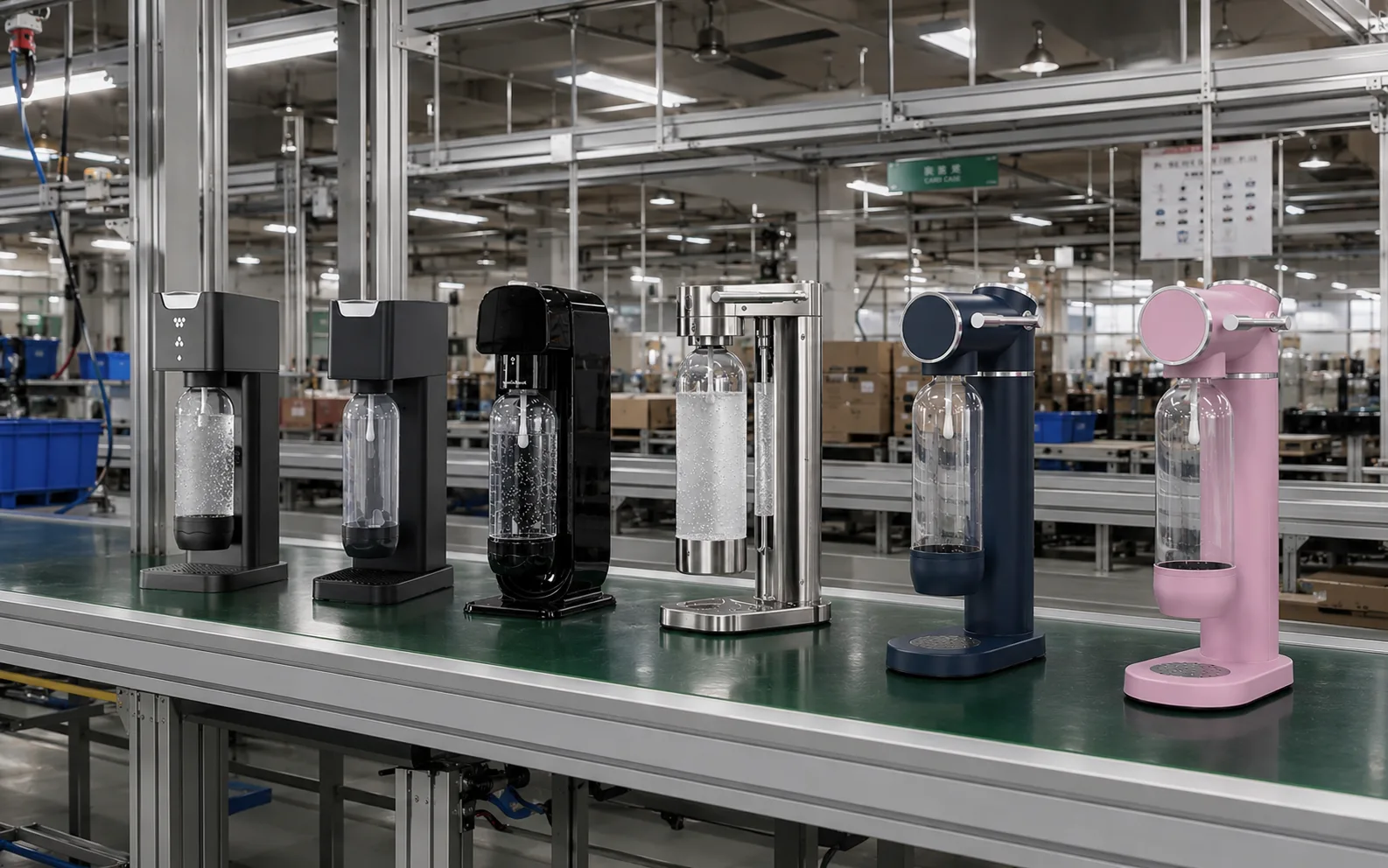
Model Selection Guidelines
Use this model guide to compare structures before opening a sample project. Buyers usually start with target market, exterior design budget, material preference, bottle compatibility, packaging scope, and expected order volume before confirming a specific model.
The range divides along three axes, and every model on this page is a point in that space. Operation: top-press (G3, G9, G8), lever (G720, G830, G15, G15 Pro) or manual press (X1). Material: all-plastic bodies for the volume programs, stainless steel for the metal programs. Head: fixed heads for the classic water-only models, detachable heads where cleaning and beverage scope matter (G8, G830, G15 Pro). A buyer who fixes those three choices has usually fixed the model — the rest of this page exists to make that fixing deliberate rather than accidental.
The most common selection mistake is choosing by photograph. Two models can look near-identical in a listing image and differ in the one property the program actually turns on — an LED, a detachable head, a mode switch — while two models that look unrelated can share the platform, the bottle and the packing maths. That is why this hub leads with structure rather than styling: pick the operation, the material and the head first, and the styling review that follows is a confirmation, not a coin toss.
Quick Model Matching Direction
Find your starting point based on key project requirements.
| Buyer Requirement | Suggested Model Direction | Related Area |
|---|---|---|
| Entry-level soda maker project | G3, G9 | Sparkling Water Maker |
| Simplest possible specification (no electronics at all) | G9 | Sparkling Water Maker |
| LED carbonation feedback for the user | G3 | Sparkling Water Maker |
| Standard private label soda maker | G8, G9 | Private Label Soda Maker |
| Lever-operation soda maker structure | G720, G830 | Sparkling Water Maker |
| Detachable head for cleaning | G8, G830, G15 Pro | Carbonated Drink Maker |
| Brand-focused stainless steel positioning | G15, X1 | Stainless Steel Soda Maker |
| Juice and multi-drink carbonation programs | G15 Pro | Carbonated Drink Maker |
| Bottle set and accessory matching | All models | Bottles |
| Compliance review before import | All models | Compliance |
Available OEM Models
Review standard model structures available for private label and custom manufacturing programs. Each card states the model's settled specification — the same facts carried on its own model page, where the full deepening (scenarios, QC, packing, FAQ) lives.
Read each card the same way: the specification line is the contract-grade summary (operation, body, head, standard set), the audience line tells you which programs actually buy it, and the project note carries the one consideration that most often changes the decision. If two cards still look tied after that reading, the tiebreaker is almost never in the card — it is in the comparison table's shipping columns or in a side-by-side sample set.
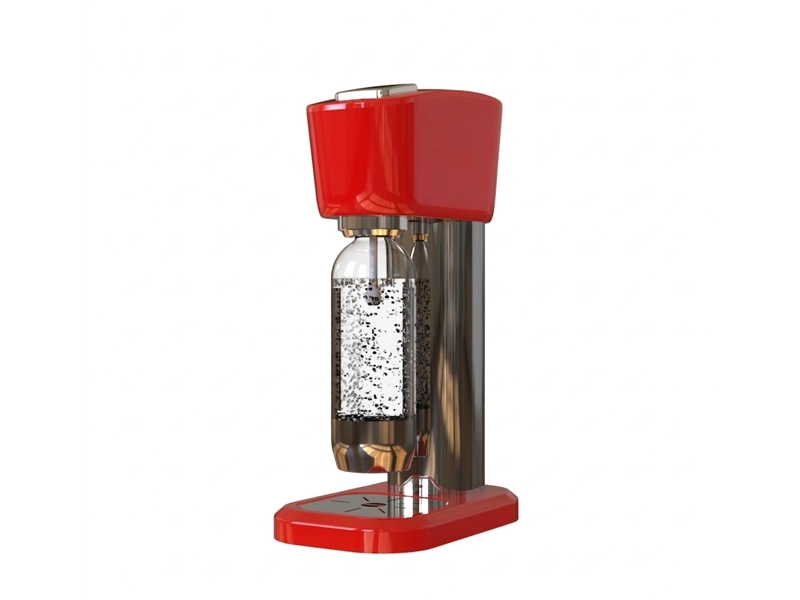
X1 Soda Maker
Positioning: Stainless steel manual soda maker model for premium OEM programs.
Specification: Manual press operation · stainless steel body · fixed head · standard set machine + 1L PET bottle (stainless base and cap) · machine 17 × 27 × 44 cm.
Suitable for: Appliance brands and private label buyers building a stainless steel range.
Project notes: Useful when buyers want a no-power manual structure with a stainless steel body and bottle trim — the compact metal entry of the range, below the G15 flagship. Standard colours are white, red and black injection colours, with further colours produced as project colours.
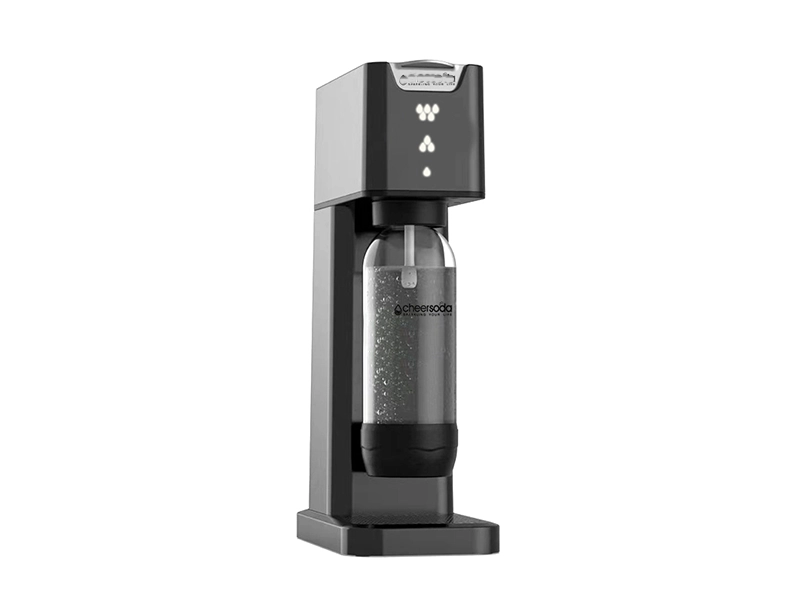
G3 Soda Maker
Positioning: Compact soda maker model for standard retail programs.
Specification: Top-press operation · all-plastic body · LED carbonation indicator (a CR123A cell runs the light only — the machine itself is fully mechanical) · standard set machine + 1L PET bottle.
Suitable for: Importers and small appliance buyers reviewing entry-to-mid range soda maker options.
Project notes: Can be discussed with color, logo, bottle set, and carton mark requirements. The LED is the user-feedback feature that separates the G3 from its twin, the G9; the cell that runs it has its documentation complete and on file, and it never touches the carbonation mechanism.
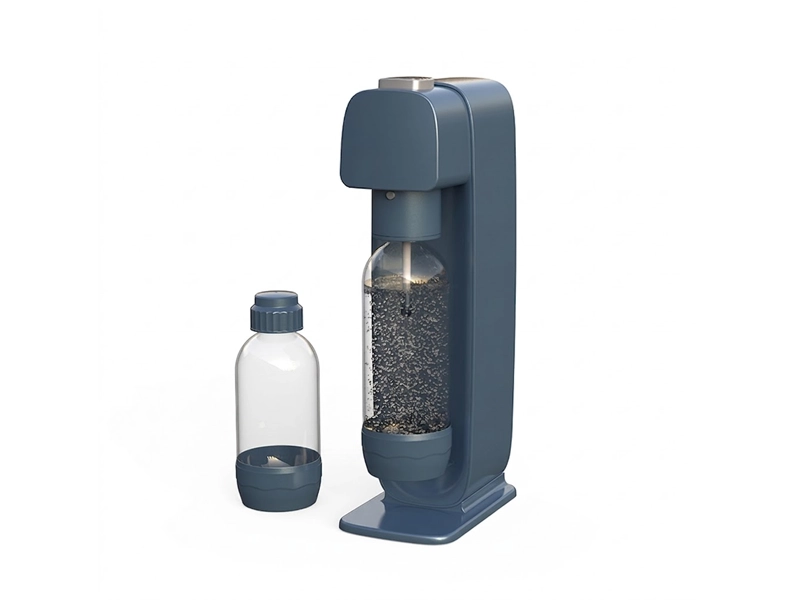
G8 Soda Maker
Positioning: Private label soda maker model for mainstream B2B projects.
Specification: Top-press operation · all-plastic body · detachable sub-carbonator head · standard set machine + 1L PET bottle.
Suitable for: Distributors, appliance brands, and retail channels needing a balanced appearance and cost structure.
Project notes: Good model reference for sample review, packaging planning, and market testing; the detachable head also opens project-confirmed trials beyond water.
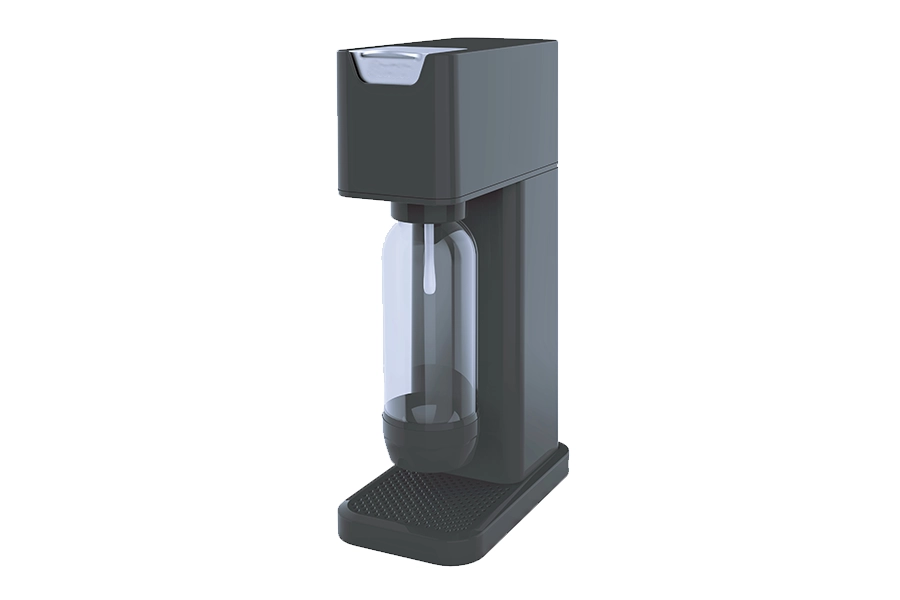
G9 Soda Maker
Positioning: The simplest specification in the range — the G3 platform without the LED.
Specification: Top-press operation · all-plastic body · no LED, no battery, no electronics of any kind · standard set machine + 1L PET bottle.
Suitable for: Buyers comparing multiple soda maker structures before tooling or packaging confirmation, and volume programs that want the fewest possible failure points.
Project notes: Useful for projects that need appearance review, bottle fit check, and compliance document planning on the range's most mechanical model.
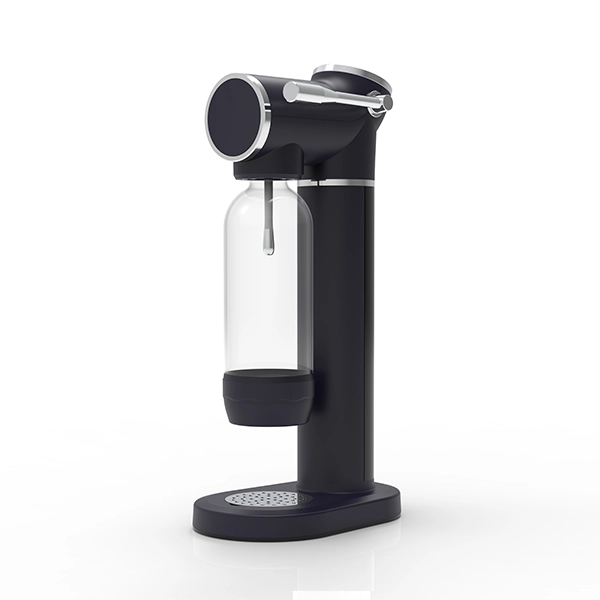
G720 Soda Maker
Positioning: Lever soda maker model for OEM product programs.
Specification: Lever operation · all-plastic body · one handle for carbonation and pressure release · standard set machine + 1L PET bottle.
Suitable for: Brands looking for a clear operating structure and production video support.
Project notes: Suitable for buyers who want to review assembly process, product handling, and packaging before bulk order. The lever is the tactile difference users feel against top-press models, and the plating trim options give private label programs a metal-look accent on a plastic platform.
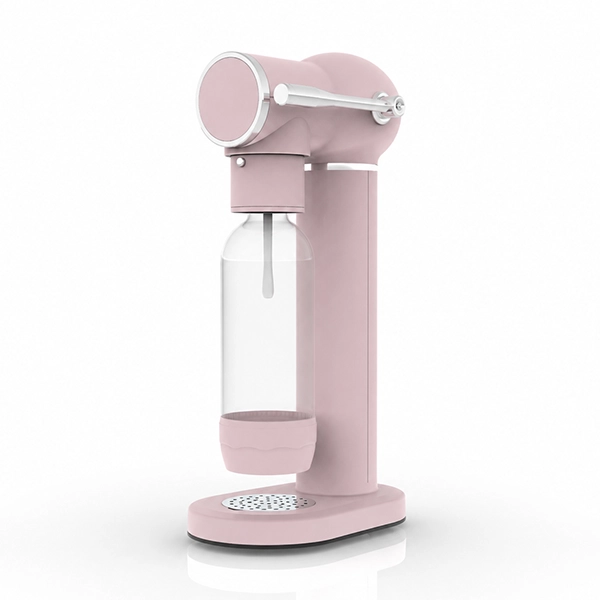
G830 Soda Maker
Positioning: Lever model with the range's most serviceable plastic head.
Specification: Lever operation (horizontal) · all-plastic body · detachable and washable sub-carbonator head · standard set machine + 1L PET bottle.
Suitable for: Buyers focused on production consistency, shipment planning, and factory capability review.
Project notes: Review together with manufacturing workflow, inspection process, and export packing requirements; the washable head supports project-confirmed beverage trials.
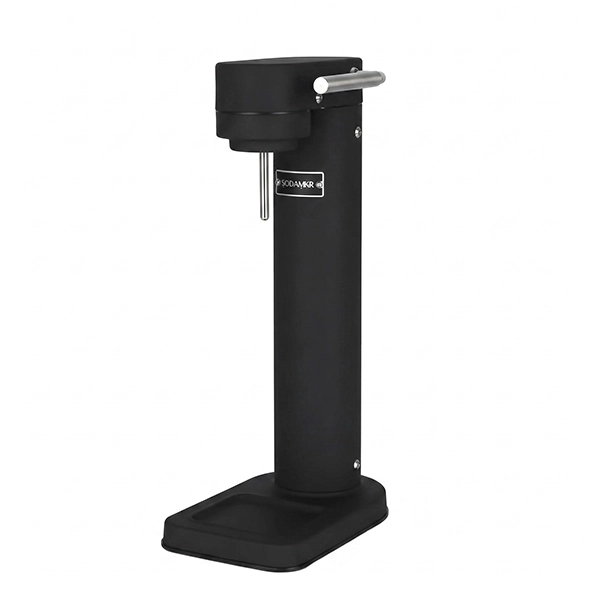
G15 Stainless Steel
Positioning: The flagship — full 304 stainless steel soda maker model.
Specification: Lever operation · full 304 stainless body · CNC brass valve core · fixed head with removable 304 nozzle · standard set machine + 1L PET bottle (stainless base and cap).
Suitable for: Appliance brands and private label buyers targeting higher-end positioning.
Project notes: Use this model when material feel, metal structure, and strong retail shelf appearance matter. Brushed or polished finish; spray finishes including matte black by project. A single-unit express carton exists for reviewer and creator seeding — a small detail direct-to-consumer programs ask about early.
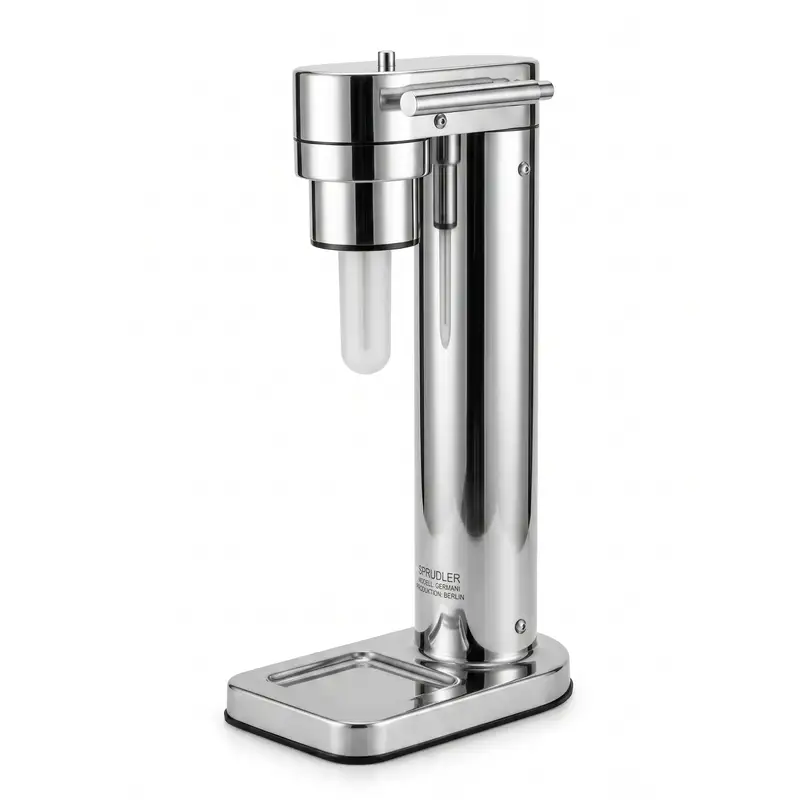
G15Pro Drink Maker
Positioning: Carbonated drink maker model for water and selected drink applications.
Specification: Lever operation · full 304 stainless body (same platform as G15) · detachable head with juice / pure-water mode switch · standard set machine + 1L PET bottle (stainless base and cap).
Suitable for: Buyers looking beyond standard water-only soda maker projects.
Project notes: Review beverage scope carefully because its function differs from regular water-only soda makers — the mode switch selects the drink type; it does not adjust carbonation strength.
Model Comparison Overview
| Model | Operation | Body | Head | Standard Bottle | Colour Box | 20GP Reference | Best For |
|---|---|---|---|---|---|---|---|
| X1 | Manual press | Stainless steel | Fixed | 1L PET, steel base/cap | 29 × 19.5 × 46.5 cm | 840 units | Compact metal entry |
| G3 | Top-press | Plastic | Fixed, LED indicator | 1L PET | 27 × 15.5 × 45 cm | 1,056 units | Entry retail with user feedback |
| G8 | Top-press | Plastic | Detachable | 1L PET | 23.5 × 21 × 45.5 cm | 1,026 units | Mainstream private label |
| G9 | Top-press | Plastic | Fixed, no LED | 1L PET | 27 × 15.5 × 45 cm | 1,056 units | Simplest volume specification |
| G720 | Lever | Plastic | Fixed | 1L PET | 23.5 × 21 × 45.5 cm | 1,000 units | Lever operation in plastic |
| G830 | Lever | Plastic | Detachable, washable | 1L PET | 23.5 × 21 × 45.5 cm | 984 units | Serviceable head, lever |
| G15 | Lever | Full 304 stainless | Fixed, nozzle removable | 1L PET, steel base/cap | 27 × 17.5 × 44 cm | 960 units | Flagship pure-water metal |
| G15 Pro | Lever | Full 304 stainless | Detachable, dual-mode | 1L PET, steel base/cap | 27 × 17.5 × 44 cm | 960 units | Juice + water programs |
Read the table by columns, not rows. Operation decides the user experience your customers will describe in reviews. Body decides the price shelf the product can sit on. Head decides the cleaning story and the beverage boundary. The last three columns decide the shipping maths your landed cost is built from — and they are close enough across the range (840–1,056 units per 20GP) that logistics almost never picks the model; positioning does. Every figure here is the reference carried on the model's own page, where the full packing set (cartons, weights, 40GP/40HQ) is stated.
Three programs, three answers, to show the framework working. A supermarket own-label buyer building a price-led water program lands on the G9 or G8: plastic, top-press, the simplest specifications, container maths at the top of the range. A premium direct-to-consumer brand lands on the G15: the same lever discipline, but a full-304 body whose finish carries the price — and it budgets the express carton because single units ship to reviewers and creators. A beverage startup lands on the G15 Pro and accepts the cleaning discipline as a product feature, because its second drink category is the whole pitch. Same factory, same cylinder standard, same document framework — three different models, each correct.
How to Choose the Right Model Direction
Why the order matters: each step forecloses options in the next. A model chosen before the market is named can fail on the cylinder standard alone; a bottle scope chosen before the model can fail on fit. And a model switched after sample approval restarts the clock — new sample, new artwork check, new document confirmation — which is why experienced buyers treat the sample-stage choice as the real decision and everything after it as execution.
The five steps take one working session to run properly, and they are the cheapest week in the whole program.
Confirm target market
Identify the regional compliance requirements and consumer preferences for structure and operation — and the cylinder standard sold locally, because every model in this range is threaded (TR21-4 / M18×1.5) and none fits Quick Connect.
Confirm product positioning
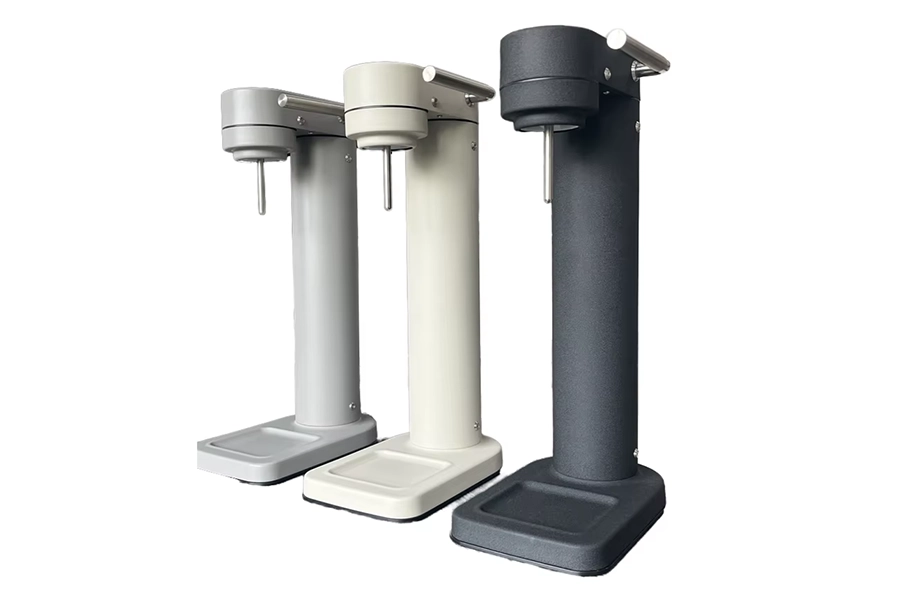
Decide between entry-level volume drivers or stainless steel or metal material focus to narrow down the model list. This single choice halves the range: plastic five one way, metal three the other.
Choose bottle and accessory scope
Determine if your project requires standard PET bottles, stainless steel variants, or specific accessory packs — bottle fit is model-specific, so this choice is confirmed on samples, not assumed from the platform.
Review logo, color, and packaging
Assess the customization boundary for private label application on the selected model structure — injection colours on plastic bodies, finishes and spray colours on metal ones.
Confirm sample, testing, and shipment plan
Align on sample review procedures, quality checks, and bulk shipment preparation timelines: samples in about 7 days, trial orders on existing models, production from the 300-unit MOQ.
OEM Options Across Models
These are the standard customization scopes available for the models listed above during private label project confirmation. The scopes are range-wide; the boundaries are per-model, and both are frozen at sample approval.
Logo Printing
Position and method confirmed per model surface.
Product Color
Injection colours on plastic models; brushed, polished and spray finishes on metal models.
Color Box Design
Your artwork on the model's standard box format.
Instruction Manual
Localized, with the model's operation and safety wording intact.
Carton Mark
Shipping marks printed to spec.
Bottle & Accessory Pack
The set composition confirmed as part of the model choice, not after it.
The full customization program — what is standard, what is project-confirmed, and how artwork is approved — is set out on the OEM soda maker manufacturer pillar and the private label page.
One boundary applies to every scope above: customization is confirmed against the physical sample, not the artwork file alone. A colour that is approved on screen is re-approved on the production body; a logo position is checked on the curved surface it will actually sit on. This is slower than approving PDFs, and it is why the approved sample — not the last email — is the document production repeats.
Bottle and Accessory Matching
Different model structures require specific bottle fit confirmations. Before finalizing a model, buyers must review PET bottle, stainless steel bottle, spare bottle set, accessory pack, and CO2 cylinder compatibility boundaries before sample approval and bulk order planning.
The platform facts are simple; the fit facts are per-model. Every model ships with a 1L PET bottle as its standard set (500 ml exists in the range; metal models carry stainless base and cap), the stainless bottle is a range accessory at its own specification, and cylinders are threaded 425g / 60L across all eight models — one cylinder standard for the whole range, which simplifies a multi-model program's accessory planning considerably. What is never assumed is the bottle-to-head fit on a specific model: that is a sample-stage check, listed in every model page's approval checklist.
Accessory planning follows the same discipline. Spare PET bottles are the highest-turnover accessory in any program and are ordered against the model, not the range; stainless bottles and extra cylinder sets are planned at quotation, when the freight maths still favors adding them. A program that fixes its accessory set at sample stage avoids the most common mid-launch scramble — discovering that the spare bottle its customers want was never in the container plan.
Manufacturing Review Before Model Confirmation
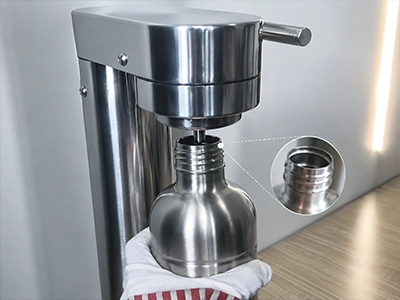
Buyers can review the factory manufacturing workflow associated with their chosen model direction. This includes understanding the parameters for injection molding, assembly, wet leak testing, packing, and shipment preparation prior to finalizing the bulk order.
All eight models run in the same Qingdao plant (15,500 m², three production lines, six injection machines, 20,000 units/month across the range) under one four-stage quality framework — incoming material check, in-process checks, comprehensive inspection, final inspection — which is why a multi-model program deals with one production relationship, one document set and one inspection standard. Model choice changes the line's work, not the factory's system. Buyers reviewing a model direction can request the line evidence for that model — assembly, testing and packing — before the sample is even built.
View Manufacturing Process →Quality and Compliance Review
Once a model direction is selected, the target market should be reviewed before bulk production. This involves reviewing food-contact materials, wet leak testing protocols, pressure-related checks, packaging inspection standards, and required document support.
The compliance position is range-wide: FDA / LFGB / CE / RoHS cover all products, whole-machine certificates are factory-held, and the factory operates to ISO 9001. What varies by model is only the evidence emphasis — food-contact parts on beverage-capable heads, the LED cell's documentation on the G3 — and every finished unit of every model passes the same 100% wet leak test and high-pressure gas check before it is packed. The review sequence is part of the protection: target market named at quotation, document set confirmed against the frozen configuration at sample approval, labels and manual checked against final artwork before printing. Programs that run the sequence in that order never chase a document after production — the delay this ordering exists to prevent, and the reason model confirmation and compliance review sit next to each other on this page.
View Compliance Details →Sample Review Workflow
Standard procedures for evaluating a soda maker model before mass production. The process in full is the sample order guide; multi-model sample sets (two or three candidates side by side) are a standard way programs use it.
Share target market and model interest
One or two candidate models from this page is the normal starting point; three is the practical maximum for a meaningful side-by-side review.
Confirm color, bottle, and packaging request
The sample is built in the intended production configuration — a sample in the wrong colour or bottle set approves nothing.
Review quotation and sample scope
Samples are charged (sample + courier quoted for your address) and ready in about 7 days.
Prepare sample and project notes
Your test results are recorded against the model page's approval checklist — operation feel, bottle lock, pressure release, cleaning, and packed presentation.
Confirm bulk order details
MOQ 300 per model; first order 35–45 days, repeats about 30. The approved sample is retained as the production reference.
Frequently Asked Questions
Common questions about model selection and specifications.
1. How many soda maker models are available for OEM projects?
2. Is the MOQ the same for every model?
3. Can I sample several models at once?
4. Do all models use the same CO2 cylinder?
5. Do all models use the same bottle?
6. Which models can carbonate juice or other drinks?
7. Which models have detachable heads?
8. Plastic or metal — how should a program decide?
9. Are lead times the same across models?
10. Can every model be private labelled?
11. What is the difference between the G3 and the G9?
12. What should I prepare before asking for a model recommendation?
Need Help Matching a Soda Maker Model?
Tell us your target market, expected order quantity, bottle requirement, packaging scope, and preferred model direction. Our export team will help narrow the model list before sample review.