
G15Pro Carbonated Drink Maker for Selected Beverages
Send the model and quantity — a formal quote lands in your inbox within one business day. Sample Fast Track: samples ready in 7 days.
Cheersoda Dual-Mode Head for Juice and Purified Water Carbonation Projects
The G15 Pro is the flagship G15 platform — full 304 stainless body, CNC brass valve core — with a detachable carbonation head that switches between pure water mode and juice mode. Carbonate water daily; carbonate juice when the program calls for it, then detach the head and wash it clean. Upper-tier metal body design, private label and OEM packaging support, and the same packing and container maths as the G15.
Designed for Beverage Equipment Projects
The G15Pro carbonated drink maker is engineered for buyers looking for a differentiated product line. It is highly suitable for beverage equipment brands, kitchen appliance brands, and private label sparkling drink projects. By supporting both juice and purified water scenarios, it allows brands to expand their market offering with a single, reliable machine head.
The differentiation is structural, not cosmetic. A standard soda maker competes on price against every other water carbonator on the shelf; a machine that also carbonates juice — credibly, with a head designed to be washed after it — opens a second conversation with the same retail buyer: sparkling juice drinks, beverage development, a premium line extension. One platform, one document set, one production relationship, two product stories. That is the commercial shape of the Pro: it is bought by programs that intend to sell more than sparkling water, and it is specified by buyers who need the beverage claim to survive contact with a real sample test — which is why this page ties every beverage scenario to sample-stage confirmation (Section 5).
It also changes who the end customer is. A water-only machine sells to households replacing bottled sparkling water; a juice-capable machine sells additionally to the home-entertaining and beverage-curious buyer the brand's marketing team actually wants to reach — the customer who posts the drink, not just the appliance. Programs feel that difference in their content pipeline: one machine generates water content and beverage content, which is why the Pro so often anchors the premium end of a launch range rather than following it.
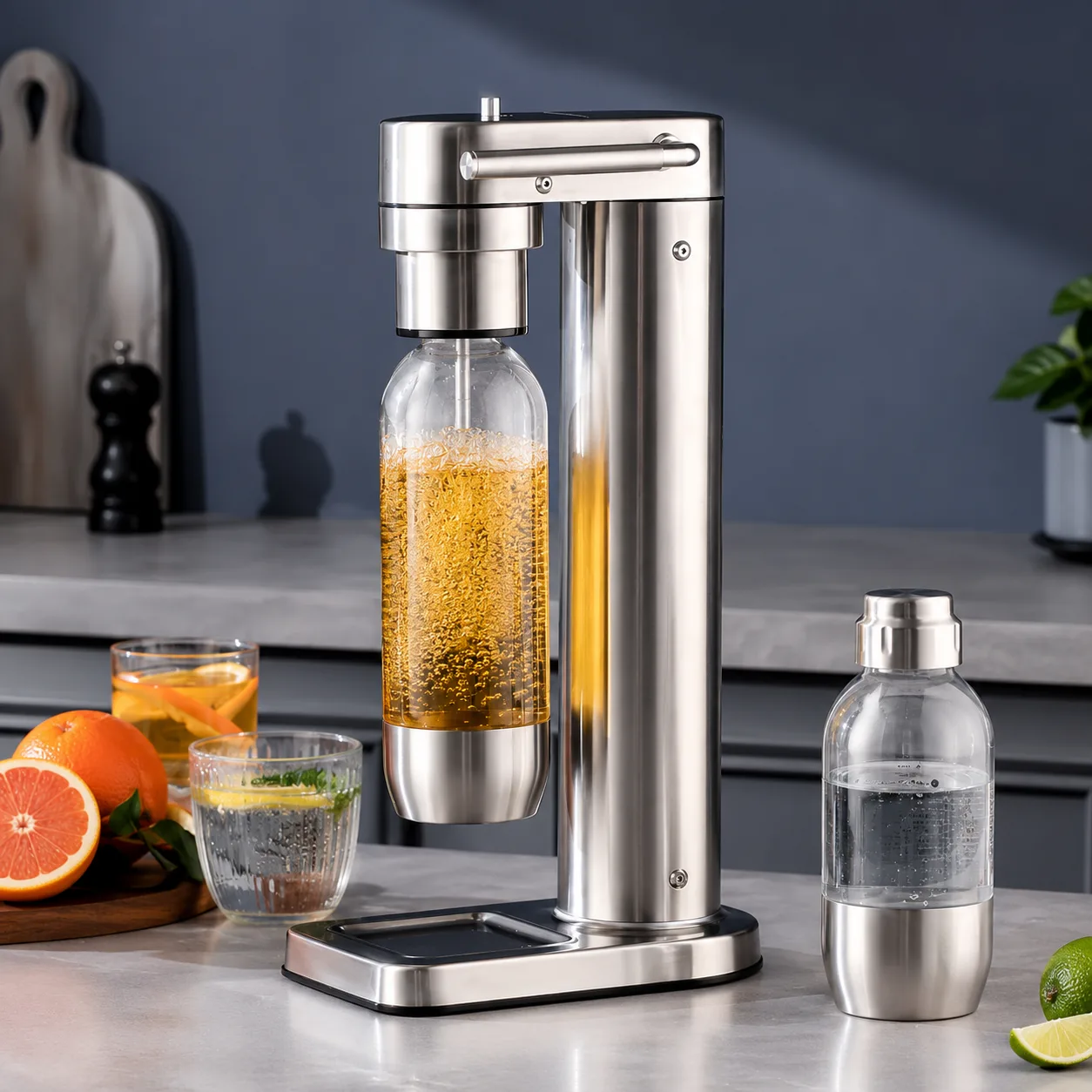
Dual-Mode Carbonation Head — Pure Water & Juice
The carbonation head is where the G15 Pro separates from the G15, and it does exactly two things the G15 head does not. It detaches from the body for washing (Section 4), and it carries a mode switch that selects between pure water mode and juice mode, so the gas path is set up for the liquid actually being carbonated.
State it plainly, because the market gets it wrong: the switch selects the drink type — it does not adjust carbonation strength. Carbonation level on the Pro is controlled the manual way, by the lever and the number of presses, exactly as on the G15. What the mode switch changes is the head's configuration for the liquid class — water on one setting, juice and other drinks on the other — with the stable pressure distribution the platform's valve design provides during the cycle.
Under the head, the platform is the G15's: a CNC-machined brass valve core, a one-piece 304 stainless nozzle (removable for cleaning), automatic pressure release and double safety valves. The Pro is not a different machine with a gadget attached; it is the flagship machine with a more capable head.
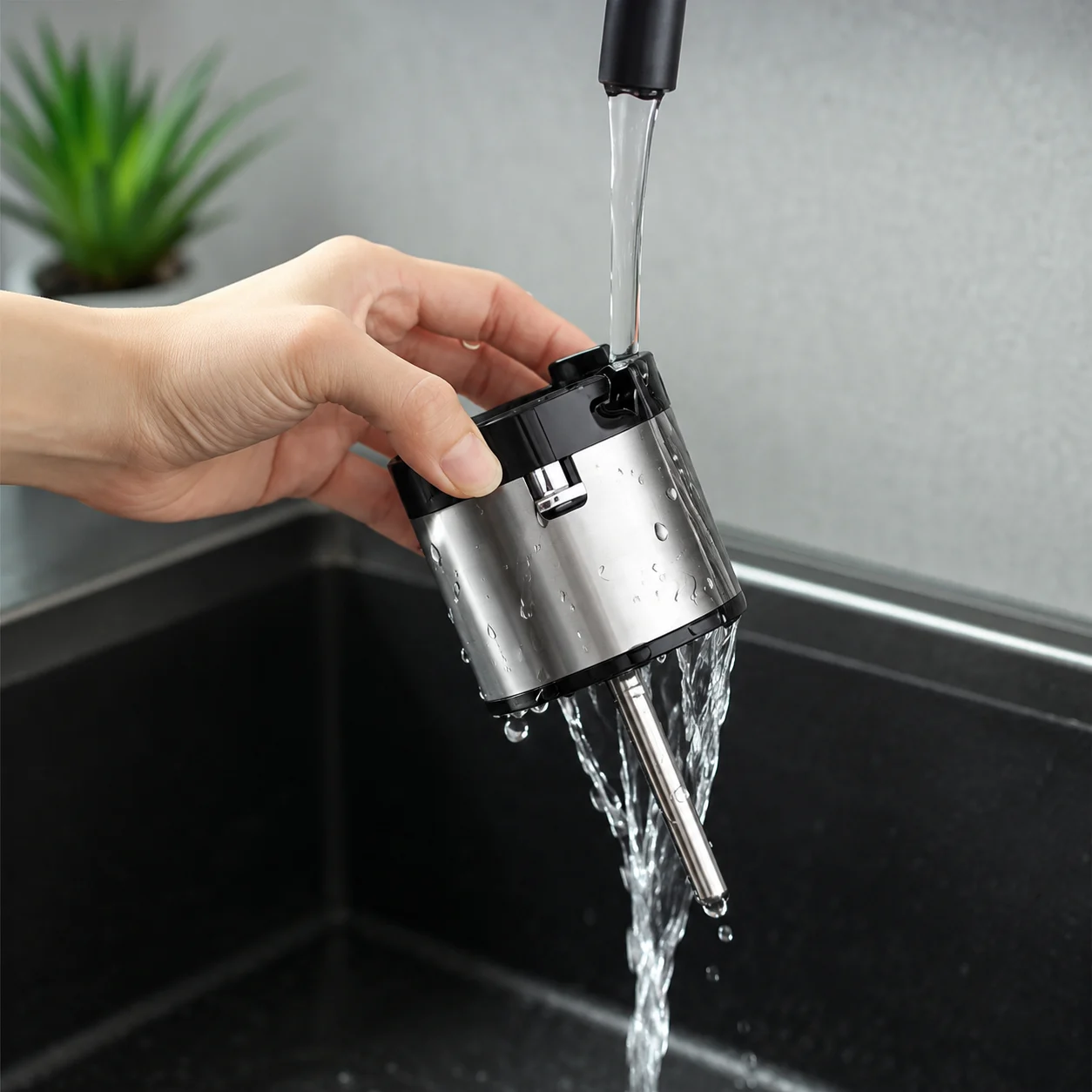
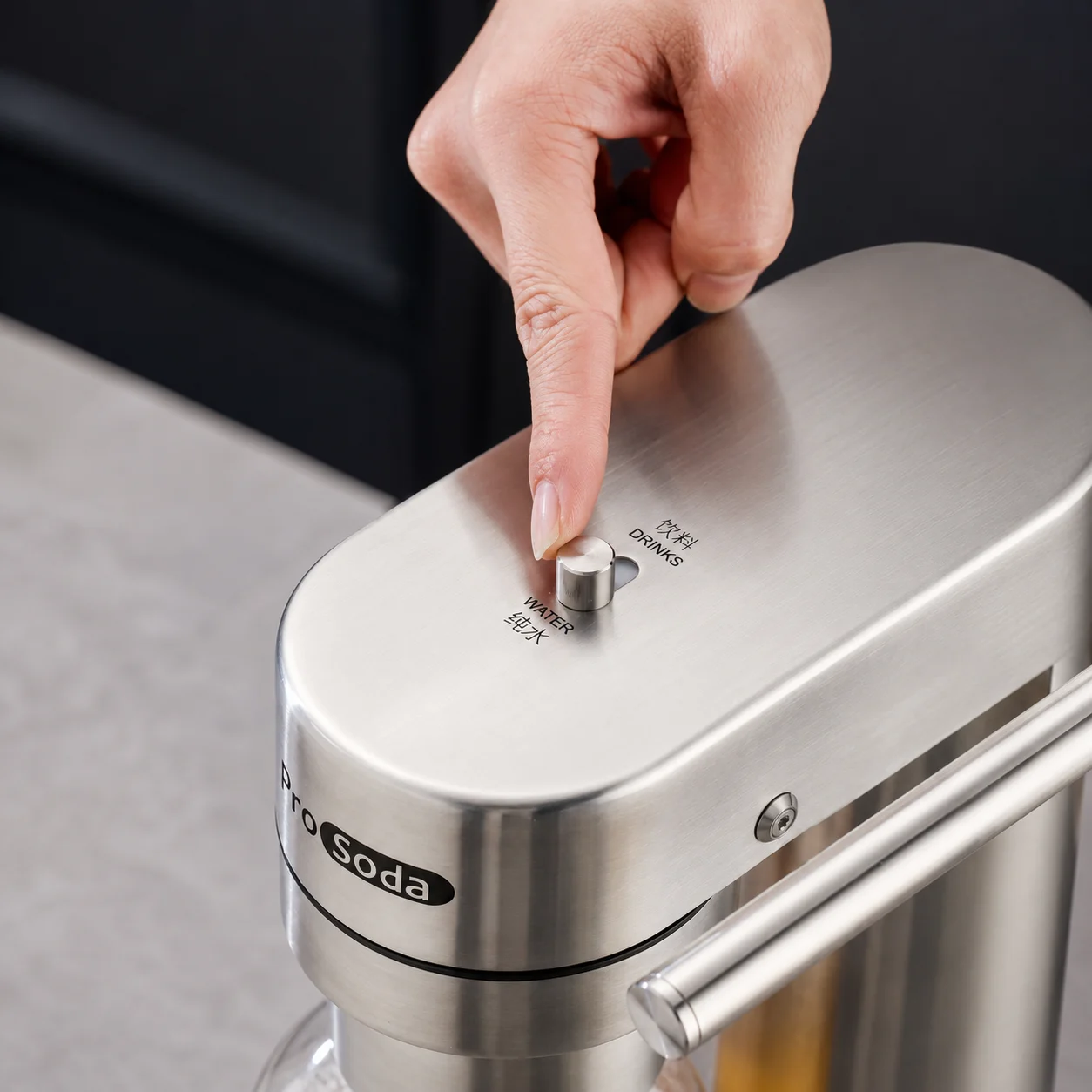
Detachable and Washable Head
When carbonating liquids other than purified water, maintaining hygiene is critical. The G15Pro features a removable head structure, allowing users to detach the head for direct rinsing — the design answer to the residue problem that ends most juice-carbonation experiments.
Key benefits for beverage testing:
Easier cleaning after juice carbonation
The head comes off the body and goes under the tap; there is no fixed gas path trapping juice residue inside the machine.
Reduced residue concern within the nozzle
The 304 stainless nozzle removes for direct cleaning, so sugars and acids are washed off the parts they would otherwise sit on.
Practical for beverage development and trial runs
A lab or brand kitchen can run a test matrix — water, juice, a syrup trial — and reset the machine to a clean state between runs.
Note: routine cleaning is required after carbonating non-water liquids to ensure the longevity of the valve system. This is written into the operation flow (Section 7) and the buyer checklist (Section 18): on the Pro, cleaning is not maintenance advice, it is part of the operating cycle for beverage use.
Supported Carbonation Scenarios
The G15Pro is engineered to handle multiple beverage types. Final liquid compatibility should be confirmed during sample testing and buyer approval.
| Scenario | Recommended Use | Buyer Note |
|---|---|---|
| Purified Water | Standard daily carbonation | Requires standard pressure check; minimal cleaning needed. |
| Juice | Fresh or clarified juice carbonation | Must detach and wash head immediately after use. Avoid high-pulp liquids. |
| Syrup-based Trial Drink | Flavor mixing before carbonation | Test foaming levels; do not exceed approved filling level. |
| Beverage Development Sample | Lab or kitchen testing for new drinks | Verify pressure release and safety boundaries during R&D. |
Read the table as a boundary document, not a menu. Water is the standard case. Juice is a designed mode with a cleaning obligation attached. Syrup-based drinks are trial territory — foaming behaviour is liquid-specific and is proven on samples, never assumed. And pulp is the hard limit: high-pulp liquids stay out, because fibrous residue defeats the cleaning routine the whole beverage case rests on. A program that respects these boundaries gets a machine that carbonates juice for years; the sample stage exists to draw the lines for your specific liquids before 300 units make them permanent.
The beverage-development row deserves its own note, because it is where many Pro programs actually start. A drinks brand prototyping a sparkling line does not need a production machine first — it needs a repeatable test bench: the same head, the same pressure behaviour, the same cleaning reset between formulations. The Pro serves as that bench, and the unit the R&D kitchen approves is mechanically the unit the retail program later ships, so test results carry into production without a translation step.
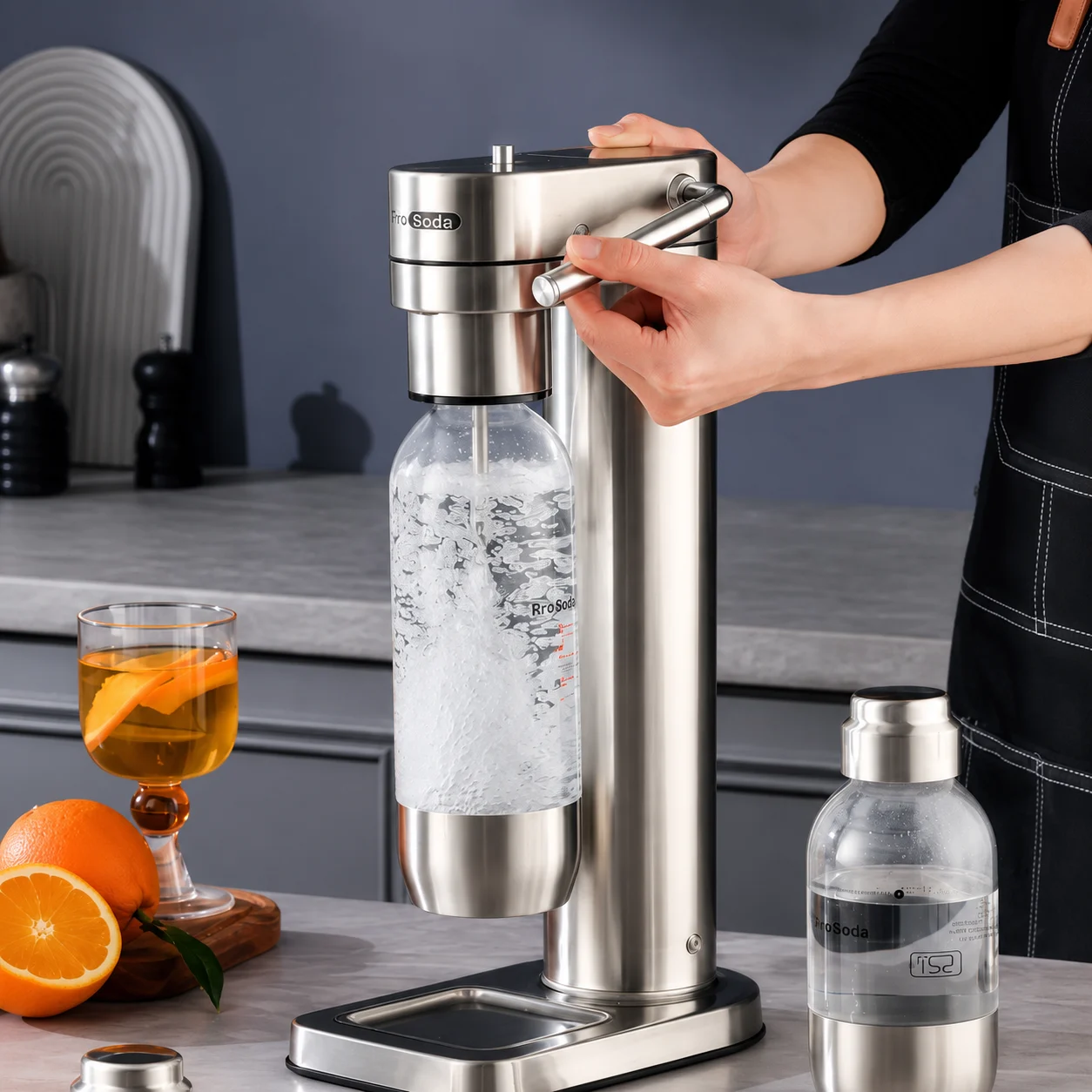
Metal Body Design
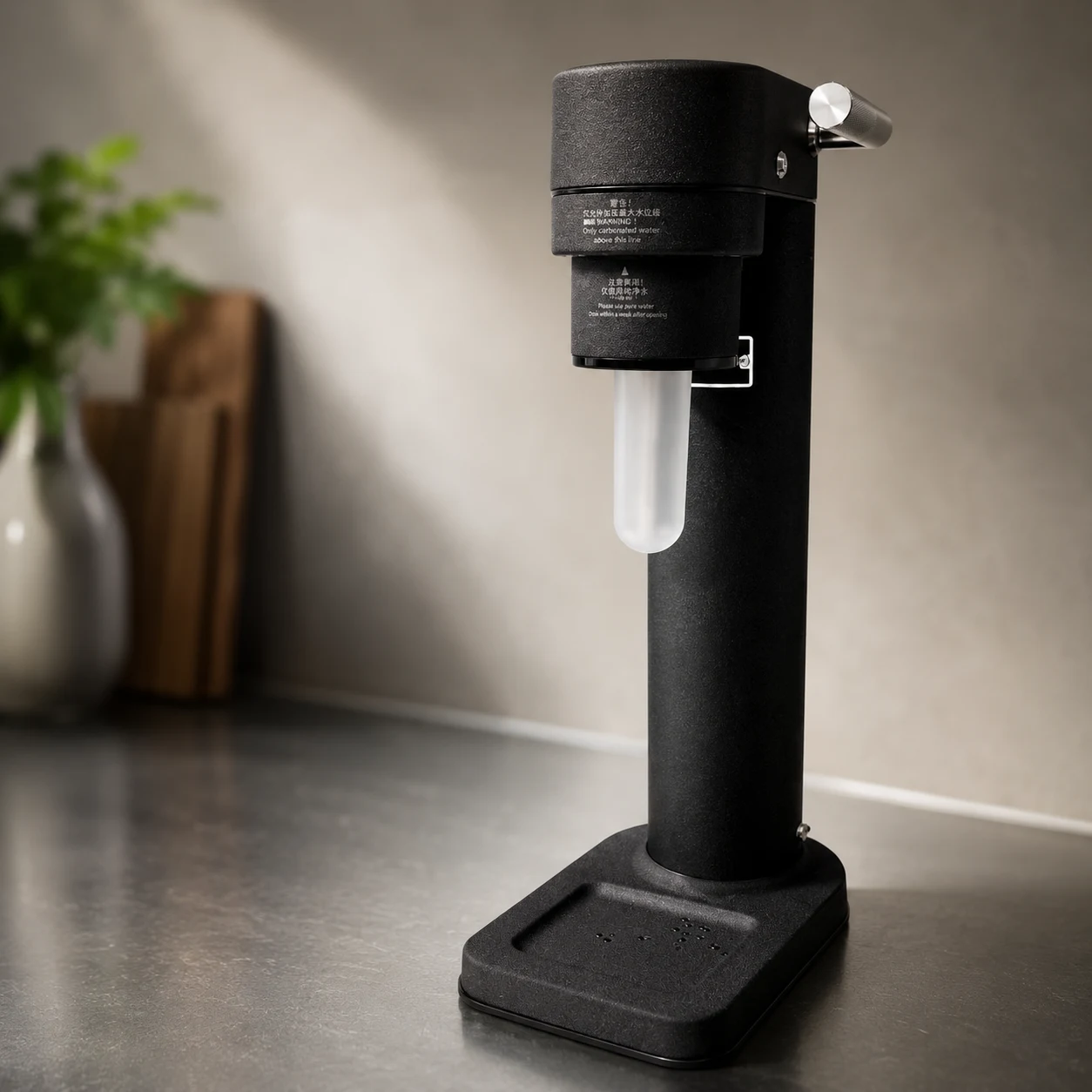
Built for upper-tier retail positioning, the G15Pro features a robust metal finish that elevates the product's aesthetic. It provides a stable countertop appearance, ensuring it fits seamlessly into high-end kitchen appliance brand lines. The heavy-duty construction not only improves durability but also creates a gift-box friendly presentation, appealing to buyers looking for a substantial, high-value product.
The body is full 304 stainless steel — the same material, finish options and construction as the G15: brushed or polished stainless as the standard presentation, with spray finishes (including matte black) produced for project orders and colour-matched at sample stage. The standard set pairs the machine with a 1L PET bottle with stainless steel base and cap — steel where the hand and the camera look first. At 23 × 14 × 41.5 cm the Pro holds the flagship's countertop stance: tall, narrow, and heavy enough at 2.0 kg net to feel like the premium object its price point claims. Both models sit on the stainless steel soda maker range page.
Manual Operation Flow
No electricity required. A straightforward process designed for reliable daily use.
Fill Bottle
Fill the bottle with approved liquid up to the designated fill line.
Lock Bottle
Securely lock the bottle into the machine's head.
Set the Mode
Select pure water mode or juice mode on the head, matching the liquid in the bottle.
Carbonate
Work the lever in short bursts; the platform's pressure sound control signals when the liquid is at pressure — pause, and add a burst if you want more.
Release Pressure
Allow the machine to perform its automatic pressure release before unlocking.
Remove & Clean
Remove the bottle. After beverage use, detach and clean the head to prevent residue.
Six steps, one decision added over the G15's flow — the mode selection in step 3 — and one obligation added at the end: cleaning after non-water liquids. Everything else is the flagship's manual discipline: fill line respected, lever in bursts, pressure released by the machine rather than by the user's impatience. A retail program prints this flow on one manual page; a beverage program prints it with the cleaning step in bold.
Safety Boundaries and Pressure Release
Operating with pressurized CO2, especially when carbonating juices or syrups, requires strict safety boundaries. The G15Pro carries the platform's full safety architecture: automatic pressure release, double safety valves, and valve assemblies design-tested at three times standard working pressure.
Controlled Pressure Release
The machine vents the bottle automatically after carbonation, ensuring safe bottle removal after gas injection — the user never opens a pressurized bottle against resistance.
Filling Level
Users must not exceed the approved filling level to prevent liquid ingress into the gas line; foaming liquids (syrup trials especially) are tested against the fill line at sample stage.
Sample Testing
Thorough sample testing is mandatory before market launch for non-water projects — liquid compatibility is a tested fact, not a brochure claim.
Residue Cleaning
Regular beverage residue cleaning is essential for continuous safe operation; the detachable head exists precisely to make this routine fast enough that users actually do it.
These boundaries are commercial as well as technical. A beverage program's warranty experience is decided by whether end users carbonate inside them — fill line respected, pulp kept out, head washed after juice. That is why the boundaries are printed in the manual, demonstrated in the video, and tested at sample stage rather than buried in a specification: a boundary the user never sees is a return the brand eventually pays for.
G15Pro Operation and Cleaning Video
Video: G15 Pro operation and cleaning (mode switch / lever carbonation / pressure release / head removal / cleaning).
The video shows the full working cycle: mode selection on the head, carbonation operation with the lever, automatic pressure release, detachable head removal, and the cleaning routine after beverage use. For beverage programs this is the listing asset that matters — it demonstrates in under two minutes the two things a still photograph cannot: that the head really comes off, and that the wash really is a rinse rather than a disassembly project.
G15 vs G15 Pro: Which Fits Your Project?
The G15 and the G15 Pro share the same 304 stainless body, the same standard set (machine plus 1L PET bottle with stainless base and cap) and the same packing dimensions. The difference is the carbonation head:
| Item | G15 | G15 Pro |
|---|---|---|
| Body | Full 304 stainless steel | Full 304 stainless steel (same as G15) |
| Bottle in standard set | 1L PET bottle (stainless base and cap) | 1L PET bottle (stainless base and cap) |
| Carbonation head | Fixed head, CNC-machined brass valve core, 304 stainless nozzle (removable) | Detachable head with a juice / pure water mode switch |
| Pressure safety | Automatic pressure release, double safety valves | Automatic pressure release, double safety valves |
| Best fit | Classic pure-water programs with a fixed-head design | Programs that also carbonate juice and other drinks, and want a detachable head for cleaning |
One point buyers often get wrong: the Pro head switches between juice mode and pure water mode — it does not adjust carbonation strength. Both models run on threaded 425g / 60L cylinders (TR21-4 / M18×1.5). Neither fits SodaStream Quick Connect cylinders, and no adapter exists — confirm the cylinder standard in your market before ordering samples. The wider range context sits on the product range page.
Detailed Specification Table
| Item | Specification |
|---|---|
| Model | G15Pro |
| Product Type | Carbonated Drink Maker |
| Operation | Manual lever (no electricity required) |
| Body | Full 304 stainless steel |
| Carbonation Head | Detachable, washable; juice / pure-water mode switch |
| Valve | CNC-machined brass valve core; 304 stainless one-piece nozzle, removable for cleaning |
| Pressure Safety | Automatic pressure release, double safety valves |
| Supported Scenarios | Juice, purified water (subject to sample testing) |
| Standard Set | Machine + 1L PET bottle (stainless base and cap, BPA-free) |
| CO2 Cylinder | Threaded 425g / 60L (TR21-4 / M18×1.5); shipped empty |
| Product Size | 23 × 14 × 41.5 cm |
| OEM Options | Custom logo, color, packaging artwork, manual |
| Sample Review | Available upon request |
| MOQ / Lead Time | MOQ 300 units; lead time 35–45 days (first order) / 30 days (repeat) |
Packing items
| Packing Item | Reference |
|---|---|
| Retail box | 27 × 17.5 × 44 cm; approximately 0.021 m³ |
| Export carton | 56 × 38 × 48 cm; approximately 0.10 m³ |
| Units per export carton | 4 |
| Express carton (single unit) | 46 × 39 × 21 cm; 3.08 kg |
| Retail box gross / net weight | 2.40 / 2.00 kg |
| Export carton gross / net weight | 10.90 / 9.60 kg |
| Container loading reference | 20GP: 960 units · 40GP: 1,920 units · 40HQ: 2,400 units |
OEM & Private Label Options
Customize the G15Pro to align with your brand identity. We provide extensive modifications for volume orders. The full program is set out on the private label soda maker page.
Branding Customization
- Logo position and printing method
- Custom body color — spray finishes including matte black, colour-matched at sample stage
- Metal finish selection — brushed or polished stainless
- Handle and accent color options
- Packaging artwork design
Project Materials Support
- Instruction manual localization
- Color box design and printing
- Barcode label application
- Carton mark specification
- Compliance documents
- Pre-shipment photos or videos
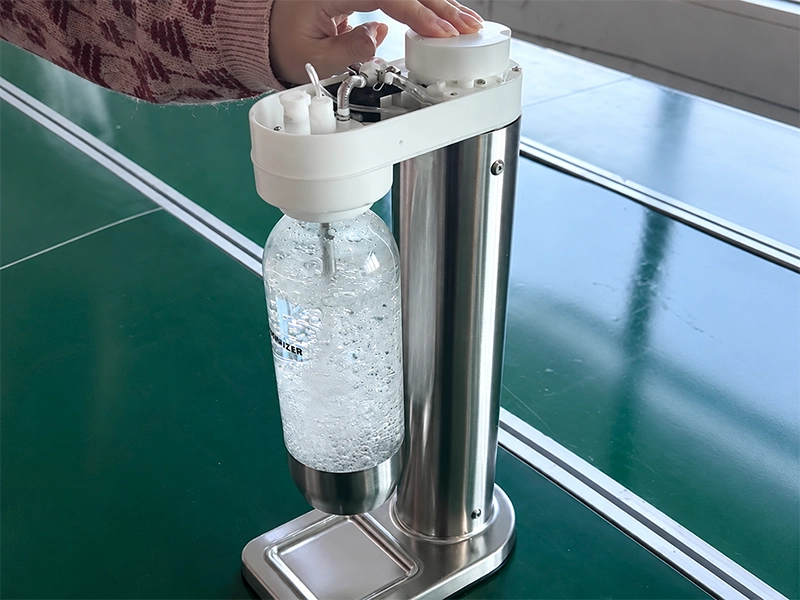
One discipline governs the list: on a beverage-positioned model, the manual is a safety document as well as a brand asset. The cleaning routine, the fill line and the mode selection must survive your localization intact — artwork is reviewed against the approved sample's manual wording (Section 18), not just against the design file. Finished OEM units and their custom color boxes are shown in the Brazil program photographs in Section 16; the program itself is documented on our case studies page.
Manufacturing and Assembly
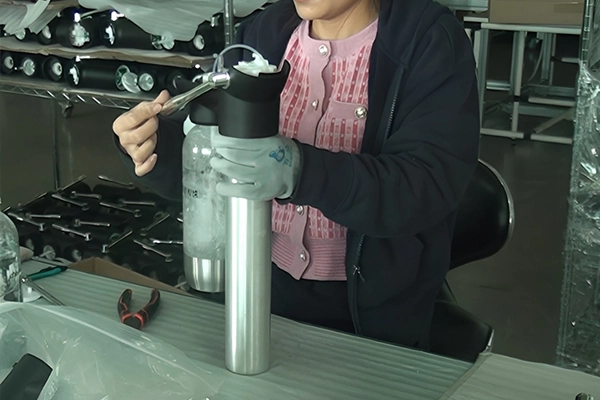
Our factory maintains strict procedural control over the G15Pro production line to ensure consistency in every unit. The line runs inside the factory's four-stage quality framework — incoming material check, in-process checks, comprehensive inspection, final inspection — documented on the manufacturing page.
Incoming Material Check.
Body, head and valve components verified against the order specification.
Head Assembly.
The detachable head is assembled and its mode switch fitted and checked.
Valve Fitting.
The CNC brass valve core and safety valves are fitted and torqued to spec.
Bottle Locking Check.
The locking interface is verified with the production bottle.
Final Inspection.
Full-cycle function and leak testing (Section 14) before the unit is released to packing.
Packaging Review.
Box, manual and labels checked against the buyer's final artwork.
Quality Control for Beverage Carbonation Projects
Because the G15Pro involves juice scenarios, our testing protocols are more rigorous than standard water-only machines. We simulate real-world conditions to verify structural integrity and safety.
- Head movement check. The mode switch is cycled and the detachable head seated and removed repeatedly.
- Detachable head fit check. Seal and fit verified after removal and refitting — the joint must perform as new after cleaning.
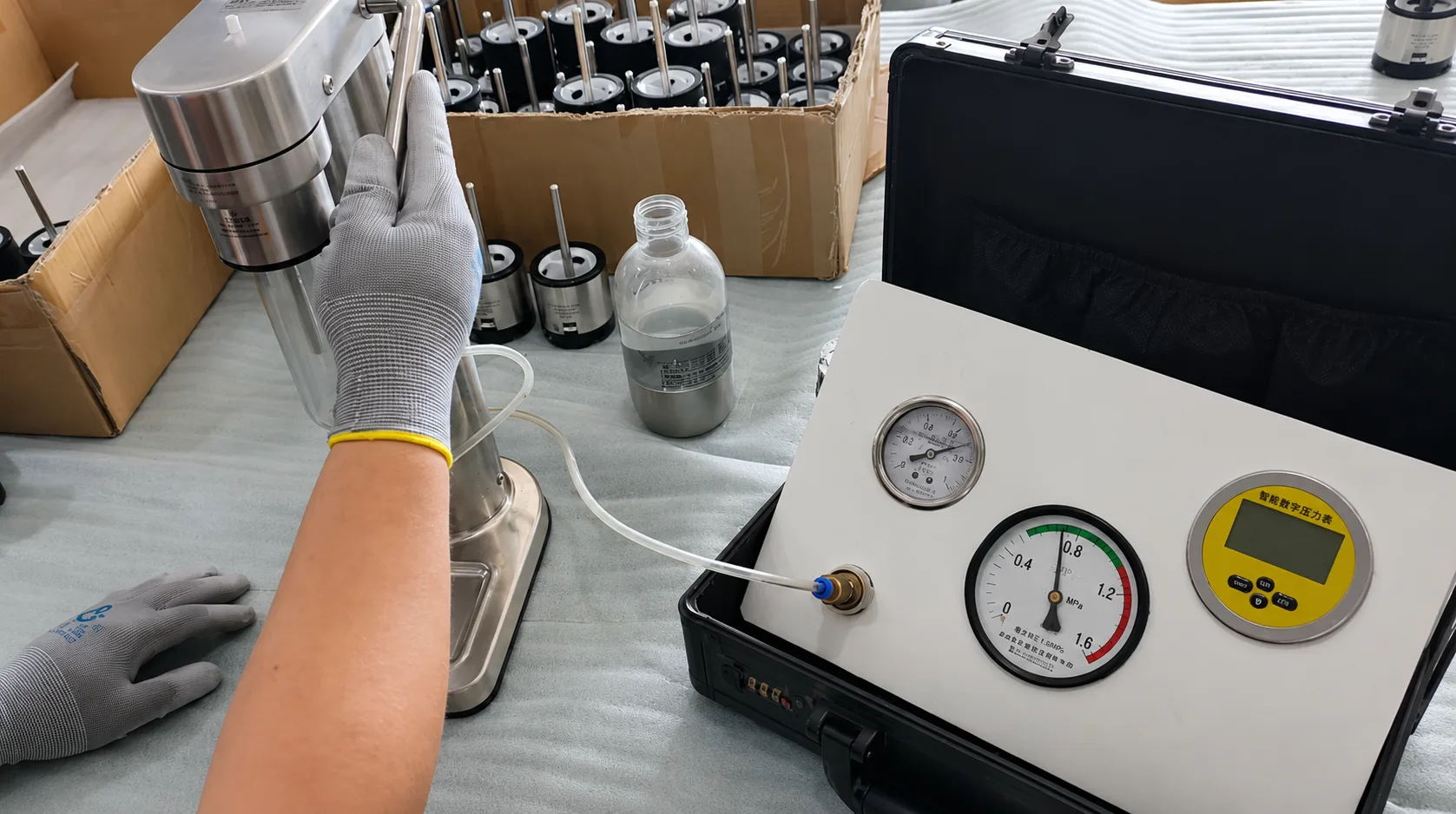
- Leak test and pressure-related test. Every finished unit passes the range's 100% wet leak test and high-pressure gas check; burst testing runs as batch sampling, with valves design-tested at three times standard working pressure in the burst-test laboratory (built 2018).
- Cleaning and residue review. The head is run through the cleaning routine and inspected — the washability claim is tested, not asserted.
- Packaging protection check. The packed unit is verified against transit damage, including a drop test on the packed product.
The framework behind the list is on the quality and compliance page.
Compliance & Document Support
Food-contact material support depends on the final configuration, bottle material, market documents, and buyer requirements. We assist our B2B partners in preparing necessary documentation for smooth market entry. FDA / LFGB / CE / RoHS cover the full range — the SFT RoHS certificate names the G15 and G15 Pro explicitly — whole-machine certificates are factory-held, and the factory operates to ISO 9001.
If applicable based on final configuration. One beverage-specific note: juice contact raises the food-contact conversation from the bottle to the head and nozzle — the parts the liquid touches in juice mode are the parts the document set must cover, which is why the configuration is frozen before documents are confirmed. Because the machine is fully mechanical, there is no electrical or battery file in any market.
The review sequence mirrors the sample sequence: target market named at quotation, document set confirmed against the frozen configuration at sample approval, labels and manual checked against final artwork before printing. Run in that order, the file that ships with the first order is the file that was approved — no document is chased after production, which is the delay this ordering exists to prevent.
Packaging and Retail Presentation
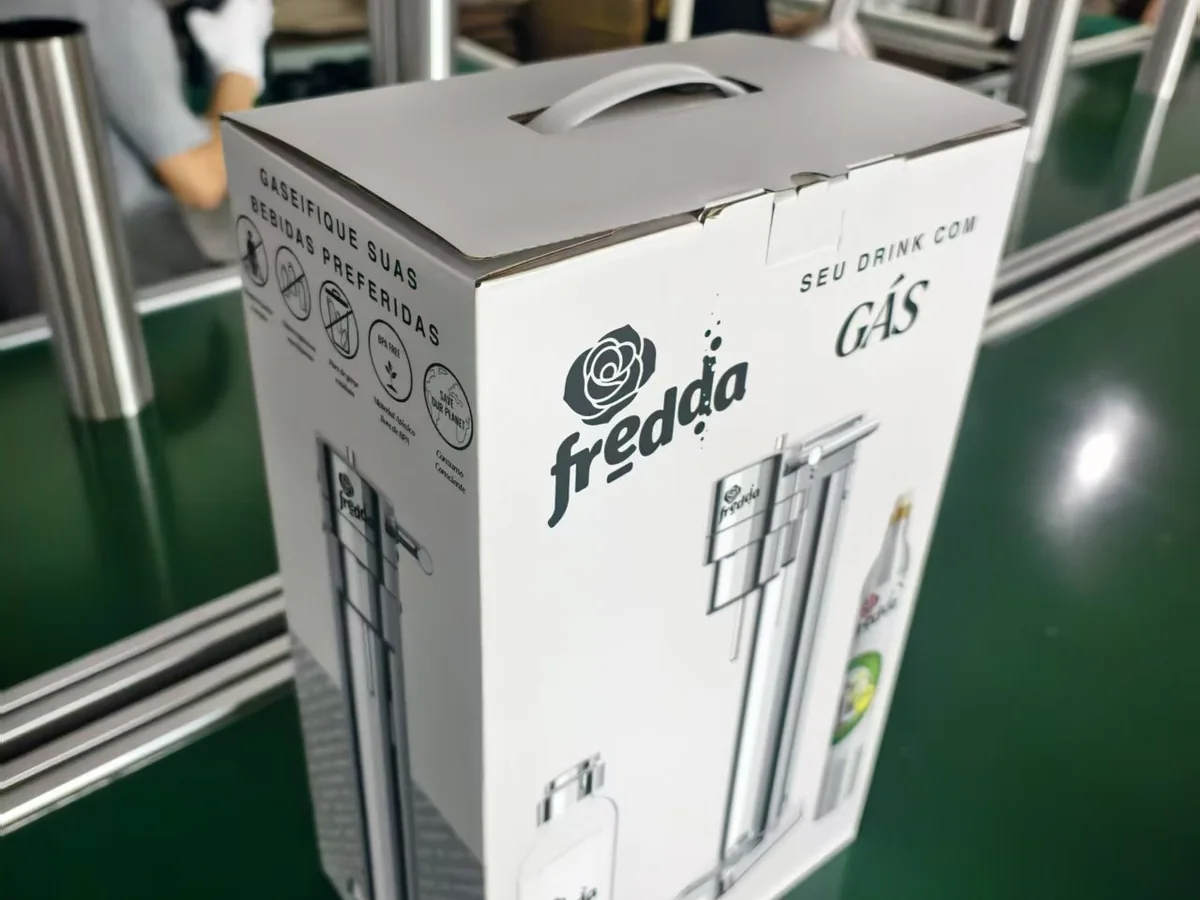
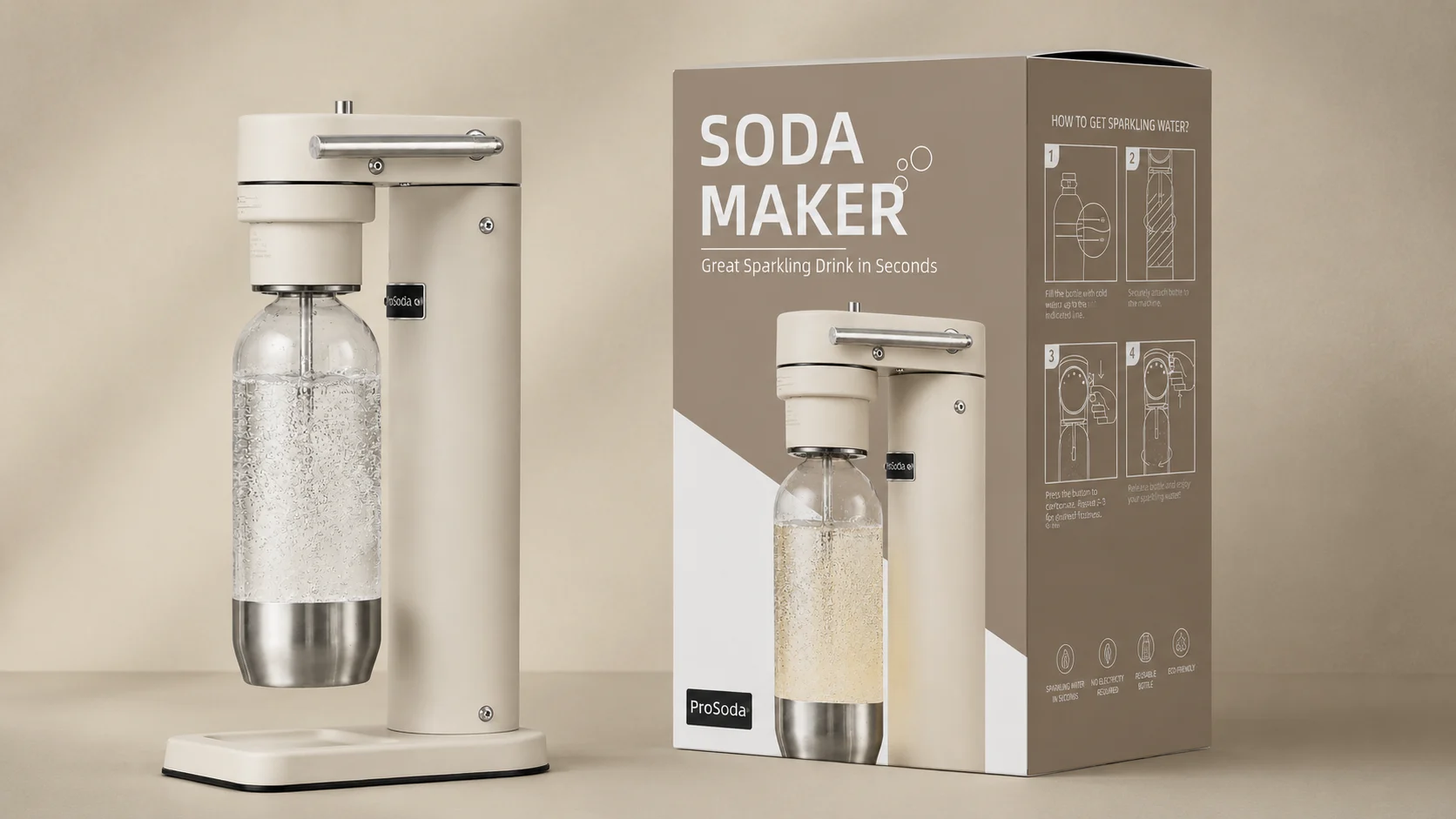
We ensure the G15Pro arrives in pristine condition, ready for retail or distribution. Standard and OEM packaging layouts are carefully designed to protect the metal body and the detachable head components.
Color box
your artwork, printed from final files
Inner foam / pulp tray
the head and body cradled against transit shock
Master carton
4 units per export carton (Section 17)
Instruction manual
localized, with the cleaning routine intact
Accessory layout
the set laid out as the customer will unbox it; bottle options sit on the soda maker bottles page
Sample approval photo
the packed presentation confirmed before production repeats it
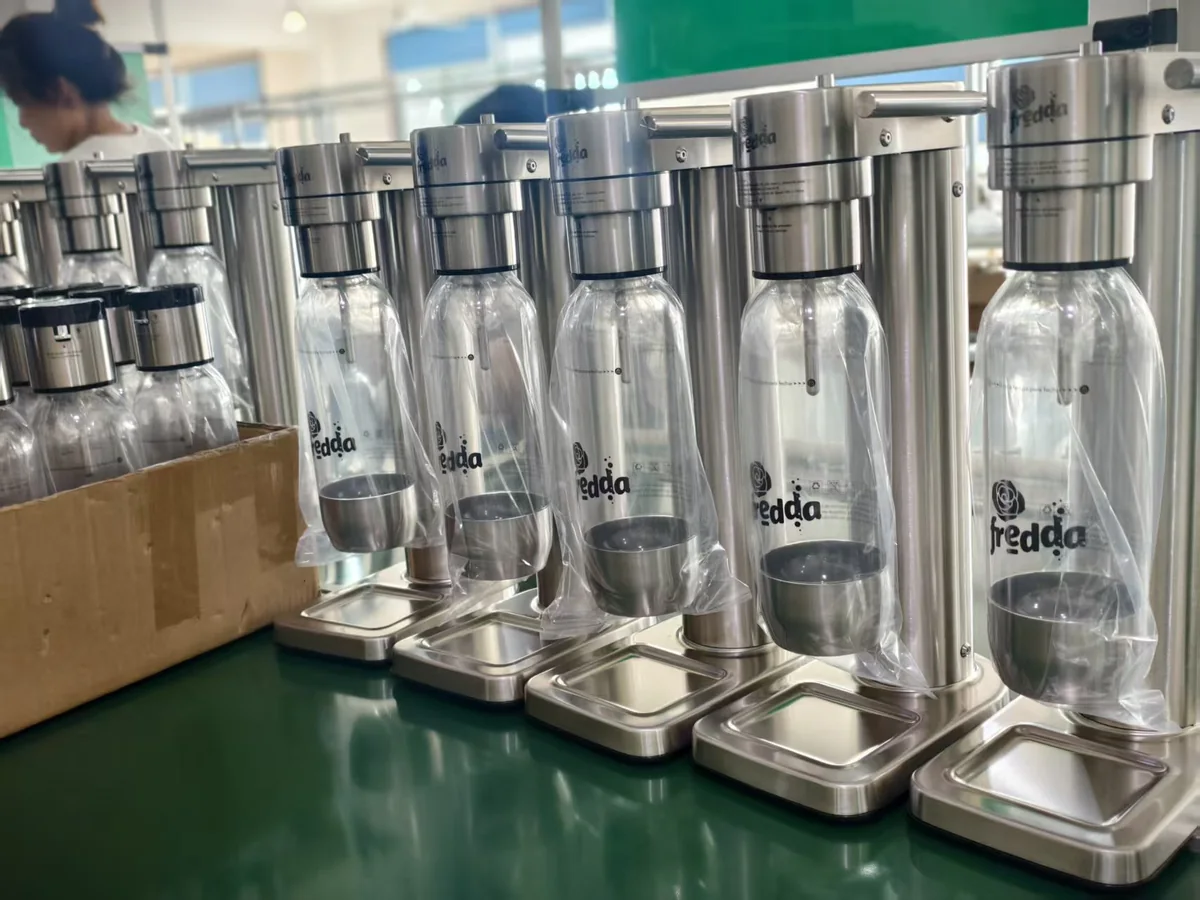
The Brazil program photographs on this page show the finished state: logo-finished G15 Pro units and their custom color boxes, packed for a market where the model carbonates more than water.
Packing and Container Loading Reference
The G15 Pro uses the same packing specification as the G15.
| Item | Specification |
|---|---|
| Colour box | 27 × 17.5 × 44 cm — GW 2.4 kg / NW 2.0 kg |
| Export carton | 56 × 38 × 48 cm, 4 units per carton — GW 10.9 kg / NW 9.6 kg |
| Reference loading | About 960 units (20GP) / 1,920 units (40GP) / 2,400 units (40HQ) |
Final quantities are confirmed against your order mix and the forwarder measurement at loading. Planning with the numbers: a 300-unit MOQ order is 75 cartons ≈ 7.7 CBM — a comfortable LCL shipment — and trial orders ship as single-unit express cartons or a small consolidated pallet for sample-market testing. Cylinders, where ordered, are quoted separately and shipped 100% empty (HS 7613001000); machines ship under HS 8422309090.
Buyer Approval Checklist
Before a G15 Pro sample is approved for production, buyers typically confirm:
- Metal finish approved — brushed, polished or spray finish on the physical sample.
- Head mode switch confirmed — pure water and juice modes both run.
- Detach and clean confirmed — head removed, rinsed and refitted by the buyer's own hand.
- Juice test reviewed — the program's actual juice carbonated and the result approved.
- Purified water test reviewed — the standard case proven on the same unit.
- Pressure release checked — automatic release observed across the test matrix.
- Bottle locking checked — fit and lock feel with the production bottle.
- Cleaning process confirmed — the routine the manual will print, timed and practical.
- Packaging artwork approved — box and presentation against final files.
- Manual wording approved — mode, fill line and cleaning wording intact in localization.
- Carton mark confirmed — shipping mark and barcode before printing.
Sample sets are prepared in about 7 days in your intended configuration and are charged (sample + courier quoted for your address), run through the sample order guide process, with quantities planned against the MOQ guide.
Helen Ho
OEM Consultant
Helen reviews every G15 Pro quotation and sample configuration personally.
Expert tip — sell the second drink, not the second feature.
Programs pitch the Pro as "the G15 with more features" and undersell it. The Pro's commercial story is a second product category — sparkling juice — carried by one machine and one relationship. Pitch the beverage program; let the detachable, dual-mode head be the evidence that the program is real.
Frequently Asked Questions
1. What is the G15Pro carbonated drink maker?
2. Does the G15 Pro's head adjust carbonation strength?
3. Can the G15Pro carbonate juice?
4. Can the G15Pro carbonate purified water?
5. Is the carbonation head detachable?
6. Why is a washable head important?
7. Does the G15Pro require electricity?
8. Can the G15Pro be used for private label projects?
9. What should buyers test before mass production?
10. What packaging options are available?
11. What documents can be prepared for OEM orders?
12. What is different about the G15 Pro head?
13. Which cylinders does the G15 Pro fit?
14. What are the MOQ, trial and lead-time terms?
Request a Quote
Contact our factory team to discuss MOQ, sample time, and private label project details.
1-Year Warranty
This model is covered by a 1-year warranty. Spare-parts planning is available based on order volume — contact our team for project-specific support.