
Launching a sparkling water maker brand is not one wait. It is three stages with three different clocks: a sample stage, a first-order stage, and a repeat-order stage. Samples are ready in 7 days, a first order runs 35–45 days, and a repeat order runs 30 days. The first order takes longest because it is also when colour, printed packaging, manual language and market documentation are settled for the first time. A buyer who plans backwards from those three stages — and settles the artwork and cylinder questions before production — is the buyer who hits a launch date.
What are the three stages?
| Stage | Lead time | What it covers | What the buyer settles first |
|---|---|---|---|
| Sample | 7 days | A sample of the chosen model, built to the agreed specification | Model, actuation style, finish and bottle |
| First order | 35–45 days | Full production, line checks, packing and shipment preparation | Colour, printed colour box, manual language, carton marks, market cylinder standard |
| Repeat order | 30 days | Production to the specification already agreed on the first order | Quantity and delivery terms; any specification change is re-confirmed first |
Samples are charged, and the fee itself is confirmed at inquiry, not stated here. The three times above are the factory’s standard stages. Anything outside the standard programme, such as private tooling or a special colour run, is confirmed separately and is not inside these three clocks.
What does the 7-day sample stage settle?
The sample stage answers one question: is this the right machine, in the right finish, with the right bottle, before any bulk quantity is committed? That is why it comes first even though it is the shortest stage. A buyer checks the carbonation action, the bottle fit and the finish against the brand’s own shelf and price position, and approves or revises before production tooling and packaging are locked.
The range the sample can come from is wide, and the actuation choice is worth settling at this stage because it changes how the product is demonstrated, not just how it looks. If the sample comes back with a revision — a different finish, a different bottle, a different carton treatment — the revision goes back through the sample stage for a fresh approval before bulk production is promised a date. That loop is the cheapest place in the whole project to change direction, and the most expensive place to skip: every correction made after bulk production has started costs the time the sample stage was designed to save. Top-press plastic models — the G3, the G9 and the G8 — press from the top. Lever models — the plastic G720 and the G830, whose head detaches and can be washed — carbonate with a visible lever action. Stainless models — the G15 and the G15Pro, whose head detaches and switches between juice and pure-water modes — carry the premium end. All of them sit inside the wider sparkling water maker OEM range, and the full range is listed on the models page.
What happens during a 35–45-day first order?
A first order is production plus everything that has never been done for this brand before. The 35–45-day first-order stage runs from sample confirmation: the clock starts once the sample is approved, not before. The machine is produced, then checked through the factory’s four-stage quality process — incoming inspection, in-process checks, combined testing and finished-goods inspection. Every finished unit, not a sample of the batch, gets a 100% wet leak test and a high-pressure gas check, with batch burst testing behind it on a sampling basis. The same checks are described in full on the quality and compliance page.
Packaging is part of the first-order clock, not an afterthought. The standard set is the machine plus its bottle — PET bottles come in 500 ml and 1,000 ml sizes, and the bottle range sets out the options — packed in a printed colour box inside an outer carton. Printed colour boxes start at 300 boxes: if a first quantity is below that print run, the balance of the boxes stays at the factory for the repeat order. Manual language, carton marks and the brand’s own naming are settled in this stage too, so the repeat order does not have to reopen them.
Carton counts belong in the same planning conversation, because they decide how many cartons a first order becomes and how it is loaded. The plastic lever model G720 packs 6 units to an outer carton of 65 × 49 × 49 cm at about 12 kg, and the stainless G15 packs 4 units to an outer carton of 56 × 38 × 48 cm. Container counts are reference figures quoted without cylinders — the G720 reference is 1,000 units in a 20GP, 2,028 in a 40GP and 2,460 in a 40HQ, while the G15 page carries the more conservative reference of 960 / 1,920 / 2,400 — and cylinders themselves are declared and shipped 100% empty. Confirming the carton count for the chosen model when the quantity is confirmed is what keeps the shipment plan, rather than just the production plan, on schedule.
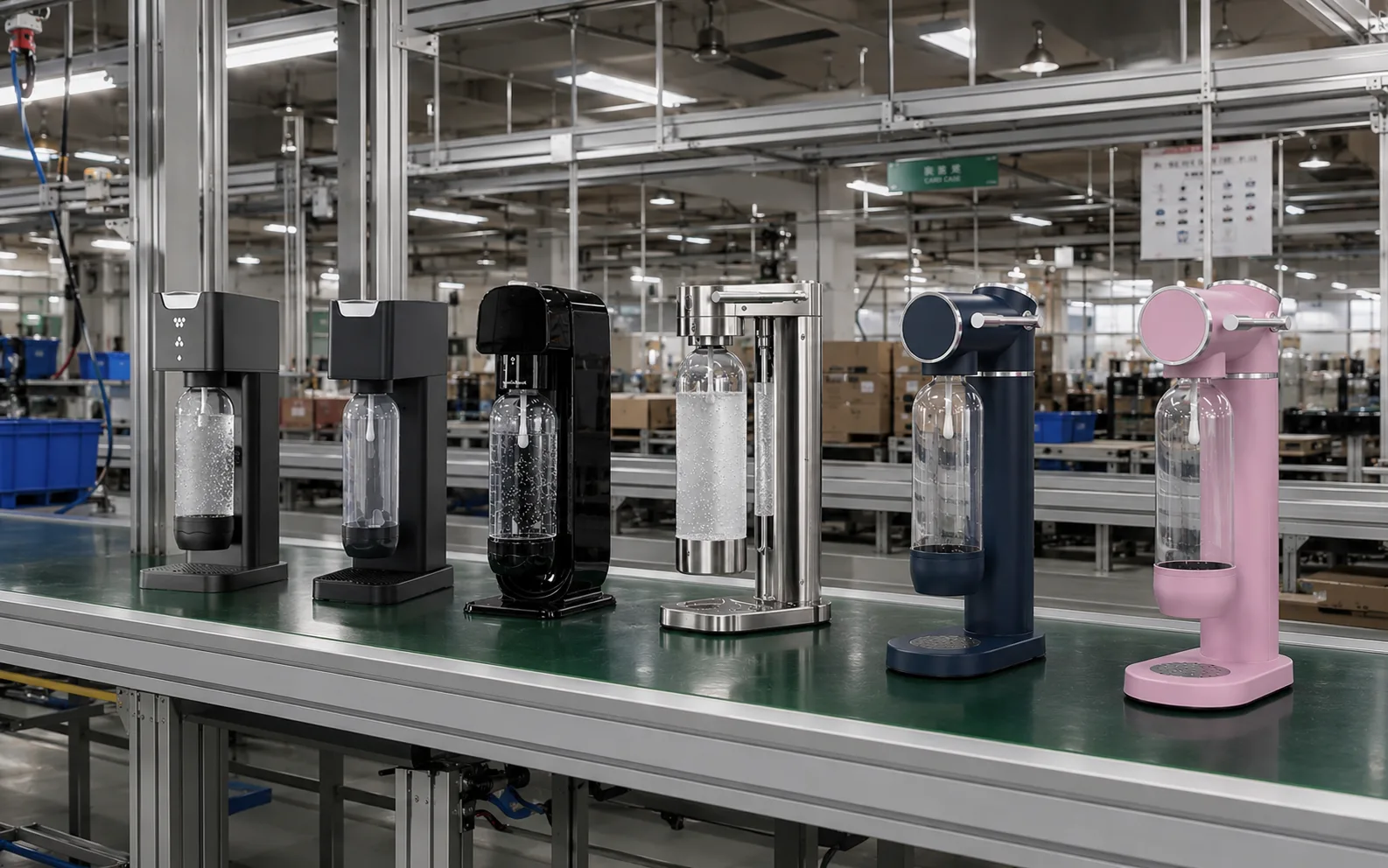
One platform, plastic to stainless — see the full OEM range and its project stages.
What most often stretches a first order?
In practice, first orders rarely slip in production. They slip in the approvals that sit in front of production, and three of them are worth settling early.
First, artwork and manual language. A colour box, a manual and carton marks in the destination language all need a buyer sign-off, and a revision round after production has started is far more expensive in time than one before it. Second, the cylinder standard for the destination market. Cheersoda machines use the threaded standard — TR21-4 valve, M18×1.5 thread, the 425 g / 60 L screw-in type — and do not fit SodaStream Quick Connect cylinders; no adapter exists. Confirming the refill pool of the destination market at the inquiry stage avoids a model decision being reopened late, and the CO2 cylinder compatibility guide sets out the distinction. Third, custom finishes. A spray colour is matched against the customer’s reference before production, and that matching step belongs in the schedule, not after it. Any change outside the standard programme — a special colour run, private tooling — is confirmed as its own timeline rather than assumed inside the 35–45 days.
Why is a repeat order 30 days?
A repeat order is shorter because the decisions are already made. The model, colour, printed box, manual language and carton marks from the first order carry over, so the stage is production, checks and packing rather than production plus approvals. That is also why the repeat clock is the one to plan a restock around: once the first order has landed and the channel’s sell-through is known, the next quantity can be timed to the 30-day stage instead of the 35–45-day stage.
One caution applies. If a repeat changes the specification — a new colour, a new box, a new manual language — treat the timeline as a fresh confirmation, not as an automatic 30 days. The revised stage runs from the re-confirmation: the clock restarts only once the change itself is confirmed.
What changes by destination market?
The machine platform does not change by market. Three things do: packaging and manual language, the cylinder refill pool, and the trade term. The same model can therefore serve several markets with different boxes and manuals, while the cylinder question and the delivery term are settled per destination. Available trade terms are EXW, FCA, FOB and DDP, and the service standard behind the schedule is a reply and a proposal within 24 hours.
For customs planning, the classification codes used on the factory’s documentation are: soda maker machine 8422309090, PET bottle 3923300000, stainless steel bottle 7323.93.00.00, and CO2 cylinder 7613001000. Certification coverage is the same across the range — CE, FDA, LFGB and RoHS cover all products — with certificate numbers held on file rather than published. The commercial terms behind any order are fixed: minimum order 300 units across the range, payment by T/T only with a 30% deposit and the balance before shipment, and a 1-year warranty. Exclusivity, where it is discussed, is agreed per model and per market, never as a blanket country claim for a public-mould product. The full service picture sits on the OEM pillar page, and branded programmes are set up through the private label route.
How do I plan backwards from a launch date?
Work backwards in the same three stages, and put the approvals first. Fix the launch date, then allow the first-order stage, then the sample stage in front of it — and schedule the artwork, manual-language and cylinder confirmations before production, not alongside it. The first inquiry goes faster when it already carries the five facts the schedule is built from: the target market, the model shortlist, the quantity from 300 units, the launch date, and the trade term preferred. With those five, the reply can confirm the stage, the sign-offs still open, and the date — rather than spending the first round establishing them. The single most useful discipline is to treat the sample approval as the gate: no bulk clock should be promised to a retailer until the sample, the colour and the box have all been signed off. After the first order lands, switch planning to the 30-day repeat stage for restocks, and re-confirm the timeline whenever a specification changes. A schedule confirmed this way is a schedule a launch date can actually stand on.
Frequently Asked Questions
How long does a sparkling water maker sample take?
7 days. The sample stage is a separate stage before the first order, built to the agreed model, finish and bottle specification, and it is the stage where the buyer approves or revises before bulk production.
How long does a first order take?
35–45 days. The first-order stage covers production, the four-stage quality process, packing and shipment preparation, including the first-time settlement of colour, printed packaging and manual language. The stage runs from sample confirmation.
How long does a repeat order take?
30 days, because the model, colour, box and manual language from the first order carry over. If the specification changes, the revised timeline runs from the re-confirmation of the change rather than staying at 30 days.
What is most likely to delay a first order?
Approvals, not production: artwork and manual-language sign-off, confirmation of the destination market’s cylinder standard (threaded TR21-4 / M18×1.5, not Quick Connect), and matching of any spray colour against the customer’s reference. Settling all three before production is what keeps the 35–45 days intact.
Can I start with less than the 300-unit minimum?
The minimum order is 300 units across the range, and that is the quantity public copy is written to. Samples do not count toward the 300-unit minimum. A smaller trial route exists and is discussed at inquiry — its route, not a quantity, is what is described here — so send the target market and model and the factory will confirm what trial route applies.
What terms apply once the order is placed?
Payment is by T/T only, with a 30% deposit and the balance before shipment. The warranty is 1 year, and valves and connectors are also sold separately as spare parts. Trade terms available are EXW, FCA, FOB and DDP.
Planning a launch date? Send the target market, the model shortlist and the launch date — we will confirm which stage your project is in, what must be signed off before production, and the schedule for the sample, first and repeat stages. See the Sparkling Water Maker OEM Range · Request a Quote