If you distribute home appliances or run a private label beverage brand, you have probably asked this question at some point: is there a dependable SodaStream alternative we can build our own line on? Not a retail clone, not a grey-market lookalike — a legitimate OEM platform you can brand, certify, and scale.
This guide comes from the factory side. Cheersoda is a Qingdao-based OEM/ODM manufacturer of home soda makers, producing for distributors and private label brands in 14 countries and regions. Below is how experienced buyers evaluate an alternative platform: the engineering checkpoints, the commercial terms, and the evidence to ask any supplier for before committing tooling money.
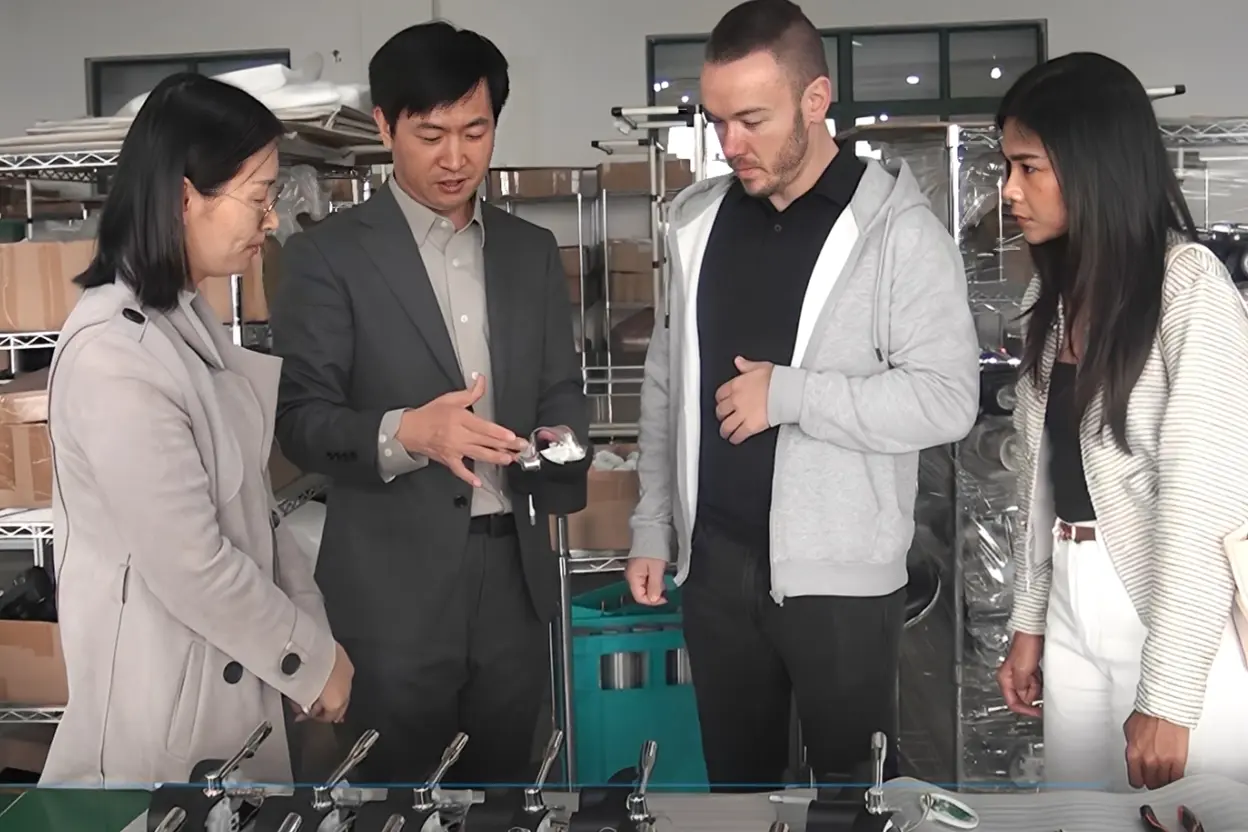
A buyer reviewing platform options at the Cheersoda factory in Qingdao.
Why Distributors Look for a Second Source Beyond SodaStream
In our experience, B2B buyers rarely come to us because they dislike the market leader’s product. They come for procurement reasons:
- Supply concentration risk. Relying on a single brand’s supply chain leaves a distributor exposed to allocation decisions made somewhere else. An independent OEM platform restores negotiating leverage.
- Margin structure. Distributing someone else’s brand means accepting someone else’s margin ladder. A private label line built on an OEM platform lets the distributor own pricing from the factory gate.
- Regional exclusivity. Brands that want a defensible territory need a supplier willing to sign it. (We offer exclusive distribution agreements; six markets — the UK, Germany, Bulgaria, Panama, Brazil and Australia — are already under exclusive arrangements.)
- Assortment control. A distributor serving both entry-level retail and premium kitchen channels needs more than one price point. An OEM partner with plastic and stainless platforms covers both without a second supplier qualification.
None of this requires the alternative to be a copy. In fact, the strongest OEM projects we have seen start from an existing, proven platform and diverge from there — different housing, different branding, sometimes adjusted tooling.
What “Alternative” Means in an OEM Context
For a retail shopper, an “alternative” is a product to buy. For a B2B buyer, it is a project: a base platform, a set of modifications, a certification package, and a production schedule. Mixing the two up is the most common mistake we see in inquiries.
A workable OEM alternative project typically includes:
- Platform selection — choosing an existing model whose mechanics, dimensions and cost structure fit your channel (our four platforms are mapped below).
- Brand application — logo, colorway, retail box and manual in your brand language. Our private label projects include custom color matching and full packaging design support.
- Tooling adjustments — where the base platform needs changes for your market. One German buyer’s project started from an existing platform with paid mold adjustments for brand and channel requirements, then scaled from a 1,000-unit trial order to 2,000- and 4,000-unit repeat batches.
- Certification alignment — confirming the model’s test files match your destination market before mass production, not after.
Private label packaging and branding options prepared for an OEM buyer.
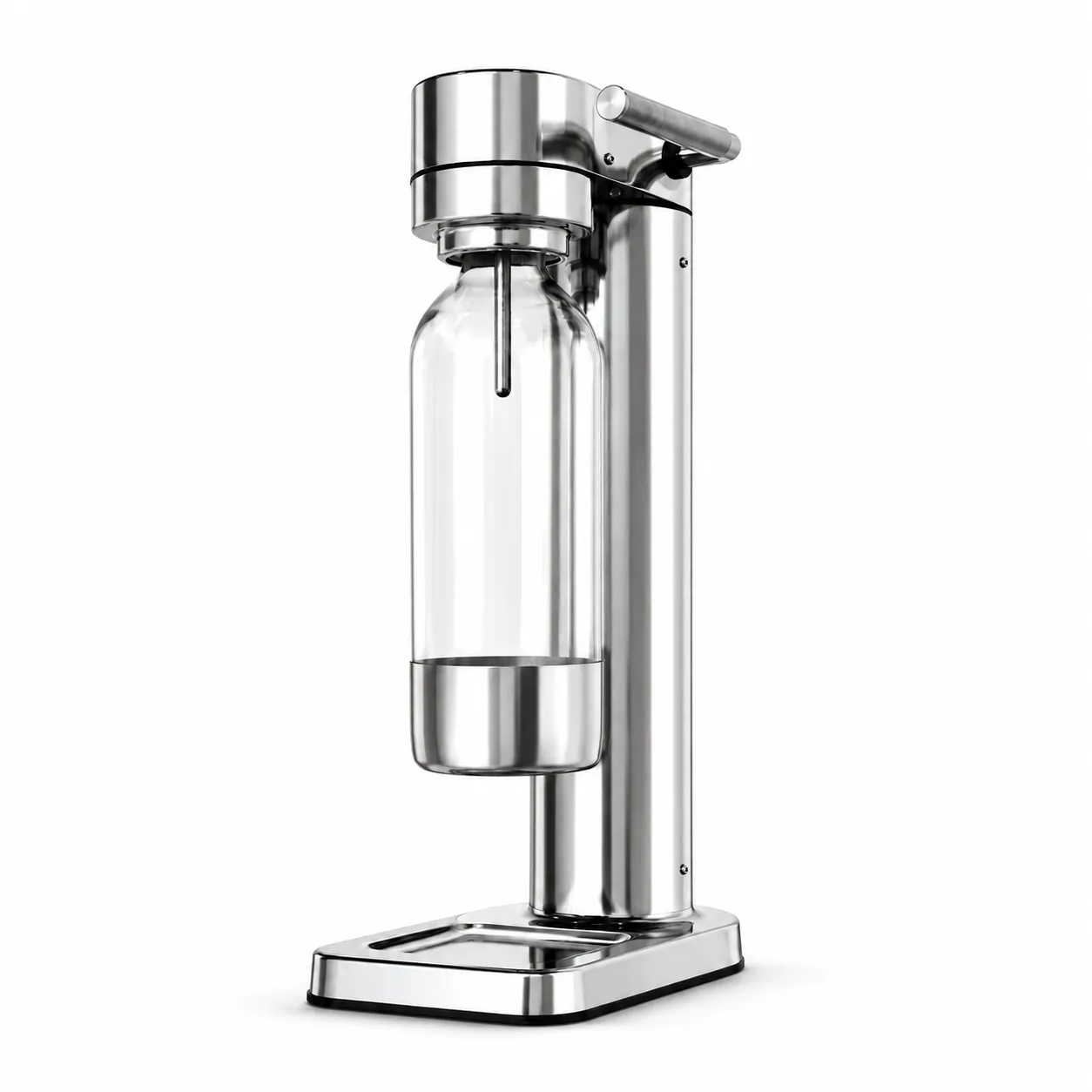
G15 — full 304 stainless steel body, CNC brass valve, double safety valve. MOQ 300 units.
See the G15 →7 Engineering Checkpoints to Compare Before Switching Supplier
When buyers compare our platform against whatever they are using now, the conversation almost always lands on these seven points. For each, we note how to verify the claim — because a specification you cannot verify is marketing, not engineering.
1. Body material and construction
Plastic housings keep the FOB in the $19–25 range and suit volume retail. Stainless housings ($35–44 range) suit premium positioning and stand up better to heavy daily use. Ask for the exact grade in writing: our G15 uses a full 304 stainless body with a CNC-machined brass valve; the G15Pro uses a 201 stainless body with a 304 stainless bottle. “Stainless look” plastic and real stainless are different products at different prices.
2. Nozzle design
The carbonation nozzle is the part buyers underestimate and service teams curse. Ours is a one-piece 304 austenitic stainless nozzle with fine-hole anti-clog geometry, detachable for cleaning. Plastic nozzles clog and ice up faster. Ask whether the nozzle detaches without tools, and what it is made of.
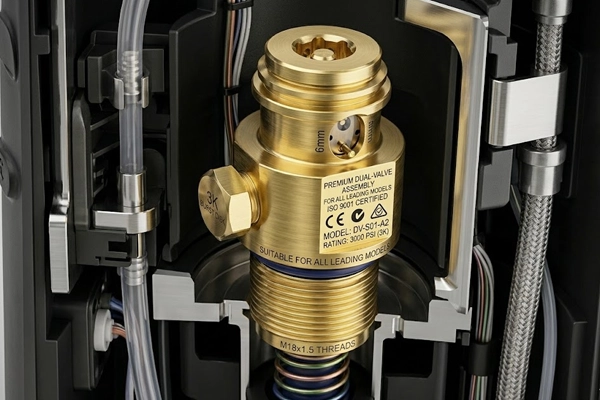
CNC-machined brass valve component — the part that controls gas release and pressure safety.
3. Pressure relief behaviour
Every pressure vessel needs a defined relief path. Our platforms relieve pressure automatically rather than relying on the user to vent manually. Two details buyers ask about on the G15: a smart pressure sound control — an audible magnetic click when target pressure is reached, with about a one-second pause at that point for better taste — and automatic valve closure at target pressure, which saves roughly 1 g of CO₂ per fill (about 10 g carbonates a liter of water). Ask any supplier to demonstrate the relief sequence on a real unit.
4. CO2 cylinder thread standard
This is a market-access detail, not a quality detail — but it decides whether your product works with locally available cylinders. TR21-4 is the common thread in Europe and most of Asia; CGA320 dominates North America. Confirm thread compatibility with your target market before tooling, and confirm which standard each model ships with.
5. Bottle material, capacity and testing
We supply both PET and 304 stainless bottles (500 ml and 1,000 ml). Whatever the material, ask for the bottle’s pressure test records and the food-contact compliance files (more on certifications below). Bottles are wear parts — ask about spare-bottle supply terms for your after-sales program too.
6. Unit-level testing, not just batch sampling
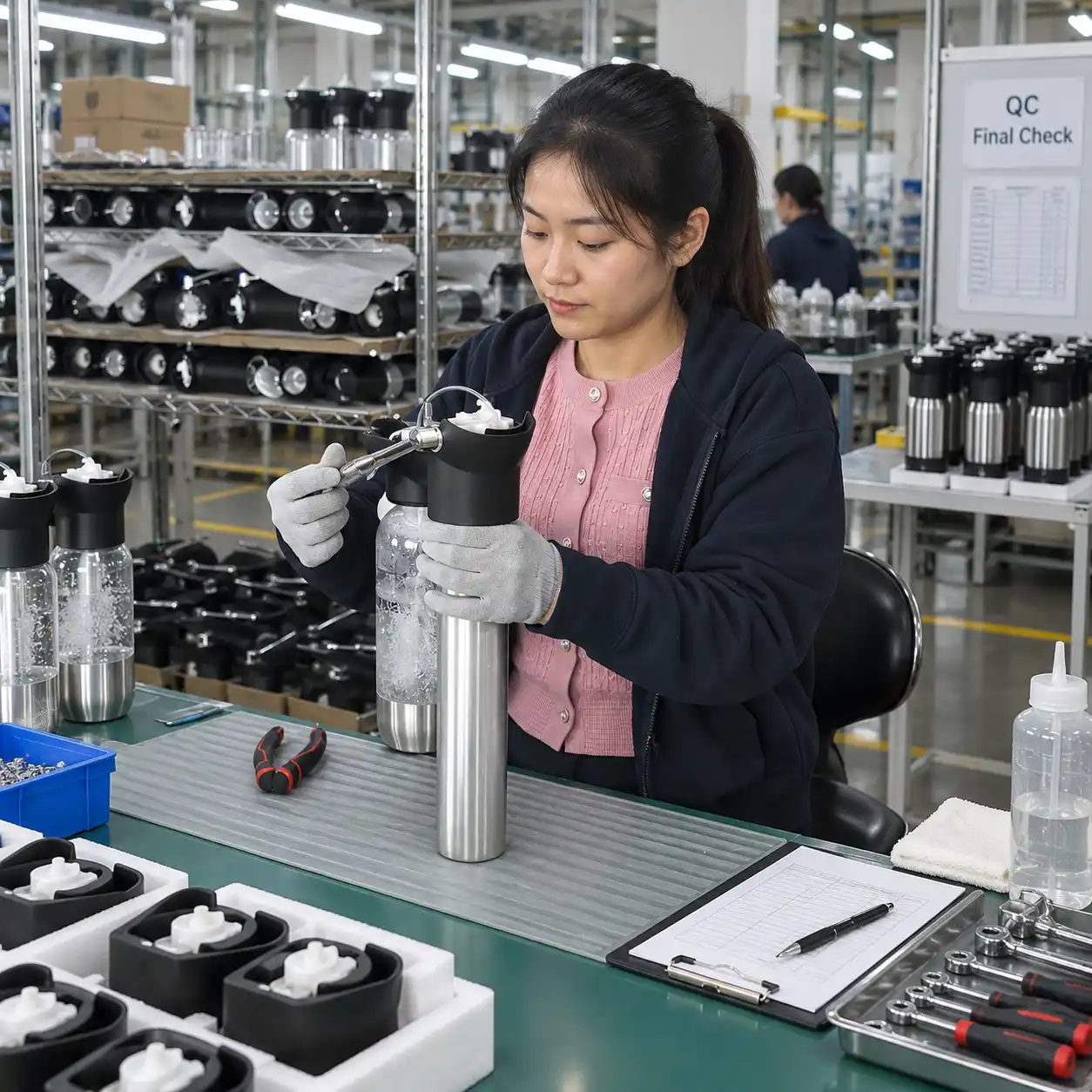
Our line runs a 100% wet test and a high-pressure gas check on every unit, plus burst testing on a sampling basis per production batch. The distinction matters: sampling-only QC catches systematic defects late. Ask to see the supplier’s actual test record format before you approve the QC plan.
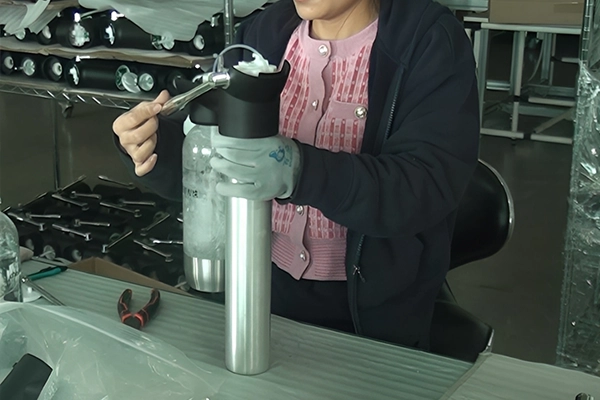
Every unit passes a wet leak test on the line before packing.
Video: pressure testing and leak check as performed for OEM orders — YouTube @cheersodamaker.
7. Surface finish and corrosion resistance (stainless models)
For stainless housings, finish quality decides both appearance and corrosion resistance in humid markets. We offer brushed and polished finishes on stainless models. Ask what salt-spray testing the finish has passed for your market’s climate exposure, rather than accepting a generic “corrosion resistant” claim.
How Cheersoda’s Platforms Map to Common Buyer Requirements
Rather than a feature-by-feature comparison against any single brand, here is how buyers typically slot our four platforms into a line plan:
| Platform | Buyer profile it fits | Key engineering facts |
|---|---|---|
| G720 View G720 → |
Volume retail, entry price point | Lever-operated standard platform; FOB reference $19–25; the workhorse for 300+ unit starter programs. |
| G15 View G15 → |
Premium kitchen channel, brand-led positioning | Full 304 stainless body, CNC brass valve, detachable 304 nozzle, automatic pressure relief with sound control and auto valve closure; FOB reference $35–44. |
| G15Pro View G15Pro → |
Buyers wanting a stainless look at a mid-tier cost | 201 stainless body with 304 stainless bottle; carbonates selected beverages beyond water. |
| G830 View G830 → |
Manual, easy-clean positioning | Manual lever operation with washable components. |
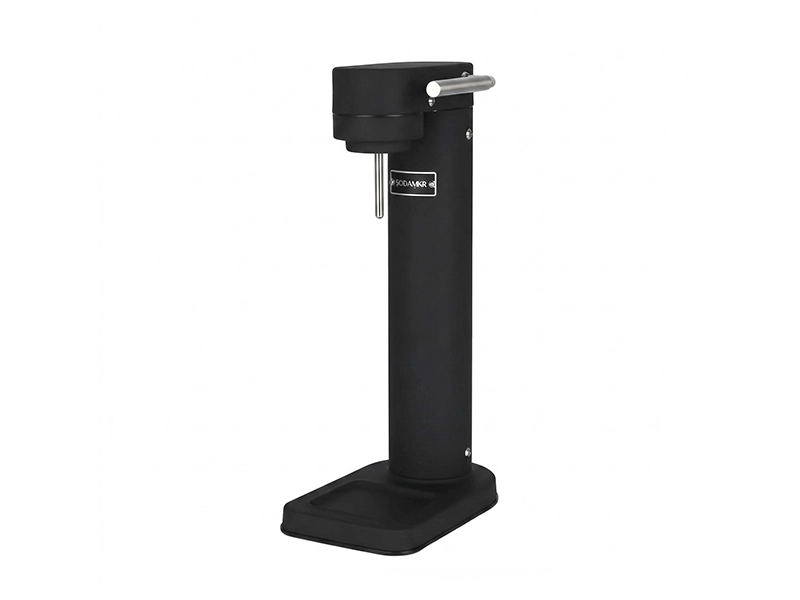
G15 in black — full 304 stainless steel body, the platform most premium private label buyers start from.
A note on compatibility: we do not claim cross-compatibility with other brands’ cylinders, bottles or accessories. Each platform is specified, tested and certified as a complete system. If cylinder interchangeability matters for your market, raise it during the engineering review — thread standards are decided per project.
Commercial Terms, Stated Plainly
Engineering gets the project approved; commercial terms get the purchase order signed. Ours:
| Item | Terms |
|---|---|
| Minimum order | 300 units across all models |
| Samples | 7 days |
| Lead time | 35–45 days first order; 30 days repeat orders |
| Payment | T/T — 30% deposit, balance before shipment |
| FOB reference | $19–25 plastic platforms; $35–44 stainless platforms (final quote per specification) |
| Warranty | 1 year |
| Response | Proposal within 24 hours of inquiry |
| Exclusivity | Exclusive distribution negotiable for all models |
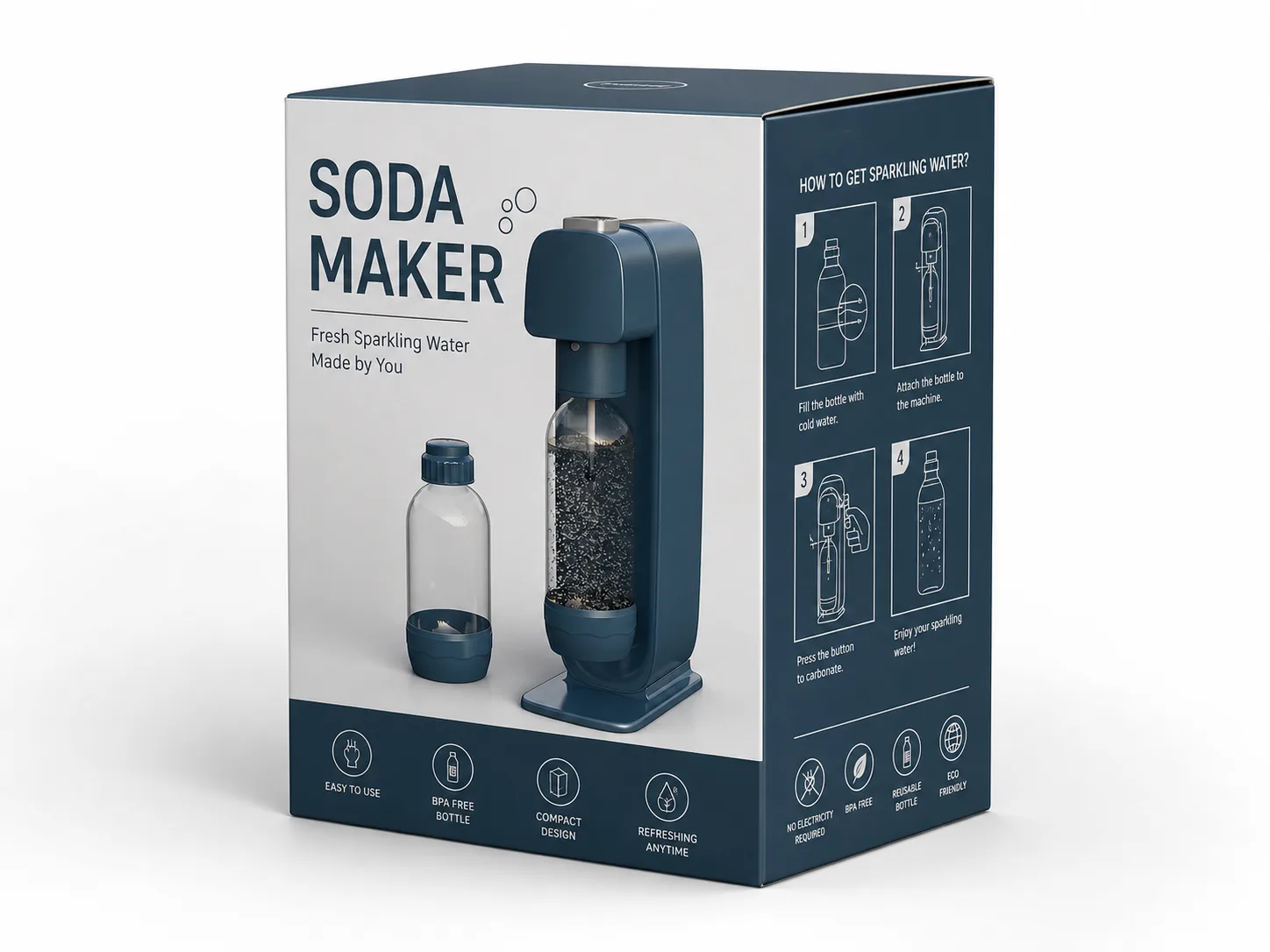
Private label retail box — packaging is designed per brand, per project.
Certifications and Factory Evidence Worth Asking For
Any supplier can list acronyms. What matters is whether the test files match your model and your market. Our four certifications — FDA, LFGB, CE and RoHS — cover all products, and model-specific files are provided during the engineering review stage.
The factory behind the platform: Qingdao Baishigao Life Electric Appliance Co., Ltd., established January 2015 in Qingdao, China. 15,500 m² facility, ISO 9001:2015, three production lines with 20,000 units monthly capacity, a four-person QC team, and six injection molding machines in-house.
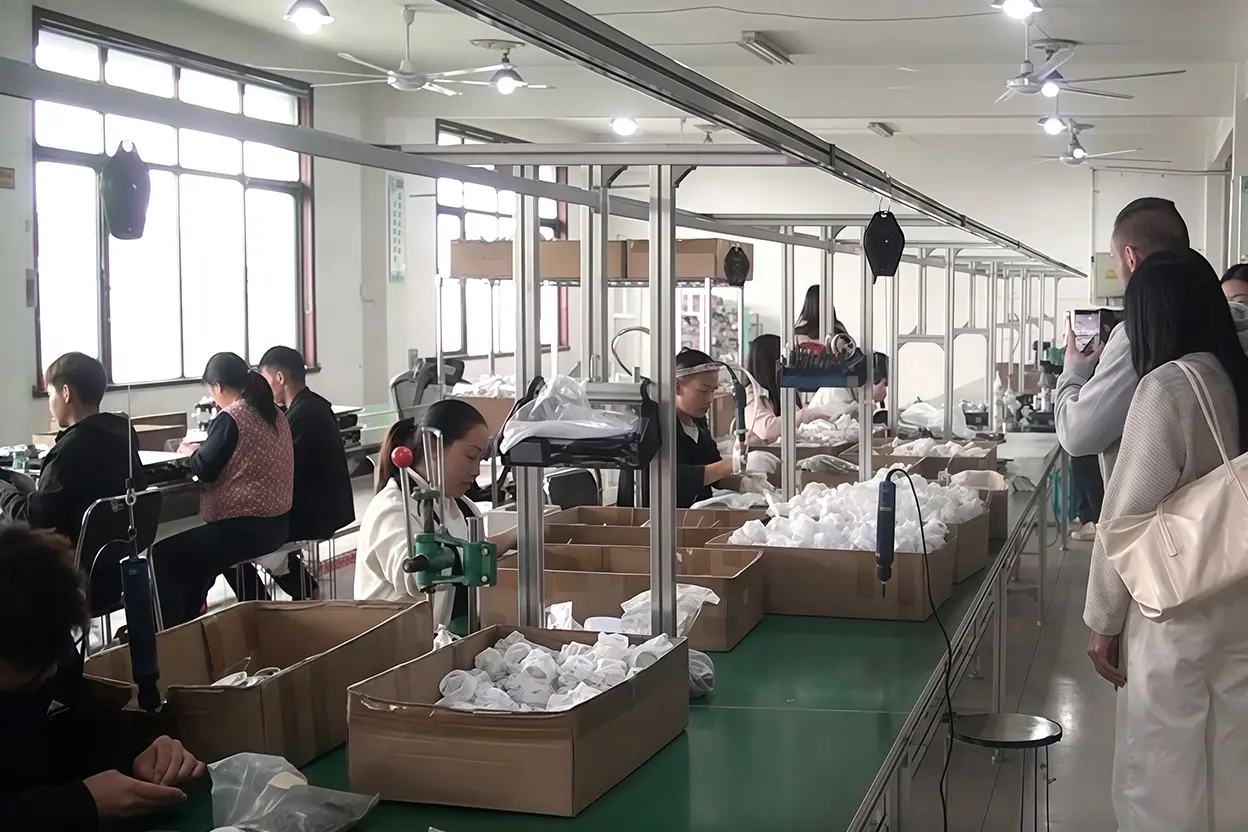
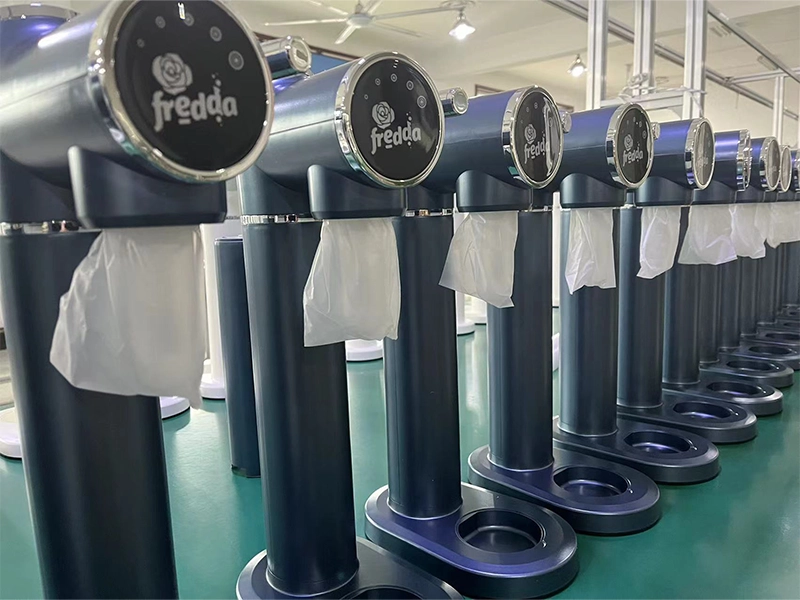
One of three production lines at the Qingdao facility.
Video: G15 assembly and appearance inspection on the line — YouTube @cheersodamaker.
Third-party track record, for reference: our Alibaba store holds a 4.9/5.0 buyer rating with 100% on-time dispatch, zero quality refunds and zero disputes across 35 recent wholesale orders (12,000+ units) from buyers in 14 countries and regions. Verified buyer feedback is published on our buyer reviews page; factory detail on our factory page.
An alternative platform still has to prove itself on paper: our quality and compliance page lists the test reports a serious private-label project should ask for.
Frequently Asked Questions
Can I build a private label soda maker line as an alternative to SodaStream?
Yes — that is exactly what our OEM program is for. You select a base platform (G720, G15, G15Pro or G830), we apply your branding, colors and packaging, adjust tooling if needed, and align certifications to your market. MOQ is 300 units.
What is the minimum order quantity?
300 units across all models, including the stainless G15. Samples are available with a 7-day lead time.
How long does the first order take?
35–45 days for the first order after sample approval; 30 days for repeat orders.
Do you support exclusive distribution?
Yes. Exclusive distribution is arranged per model and per market. Some existing customers hold exclusivity for specific models in their markets, so share your target model and country and we will confirm availability for your project.
Which CO2 cylinder thread do your models use?
Thread standard is confirmed per project and per market: TR21-4 is common in Europe and most of Asia, CGA320 in North America. Confirm your target market’s standard during the engineering review.
Are your soda makers certified for the EU and US?
Compliance documents, including FDA, LFGB and RoHS test reports for food-contact materials, are available for project review. Model-specific test files are provided during the engineering review stage.
Discuss Your OEM Project
Tell us your target market, channel and volume — we will return a platform recommendation with pricing within 24 hours.
Related guides: OEM soda maker manufacturer, private label soda maker, CO2 cylinder compatibility guide and soda maker models.